Table of contents
- Brand Identity Prism by Kapferer: The 6 Facets That Define a Brand
- What Is Kapferer’s Brand Identity Prism?
- The Six Facets of Kapferer’s Brand Identity Prism
- 1. Physique
- 2. Personality
- 3. Culture
- Brand Culture vs Company Values
- 4. Relationship
- 5. Reflection
- Reflection Is Not the Same as Target Audience
- 6. Self-Image
- Reflection vs Self-Image Explained Simply
- Kapferer’s Brand Identity Prism Template
- The Two Axes of the Brand Identity Prism
- Why Is the Brand Identity Prism Useful?
- Using the Prism for a New Brand
- Using the Prism for Rebranding
- Brand Identity Prism Example: Hypothetical Egyptian Coffee Brand
- Brand Identity Prism Example for a B2B Technology Company
- Brand Identity Prism Example for a Luxury Brand
- How to Create a Brand Identity Prism
- Step 1: Research the Market
- Step 2: Research Customers
- Step 3: Define Positioning
- Step 4: Define Culture
- Step 5: Define Personality
- Step 6: Define Relationship
- Step 7: Define Reflection
- Step 8: Define Self-Image
- Step 9: Define Physique
- Step 10: Test Coherence
- Brand Identity Prism Workshop Questions
- How to Know if Your Brand Identity Prism Is Weak
- Brand Identity Prism vs Brand Archetypes
- Brand Identity Prism vs Brand Positioning
- Brand Identity Prism vs Brand Essence
- Brand Identity Prism vs Brand Guidelines
- Brand Identity Prism vs Brand Image
- Internal Identity vs External Image
- The Brand Identity Prism and Visual Identity
- The Brand Identity Prism and Tone of Voice
- The Brand Identity Prism and Customer Experience
- The Brand Identity Prism and Rebranding
- The Brand Identity Prism for Product Brands
- Brand Identity Prism for Egyptian Brands
- Local Brand vs Global Brand
- How Udjat Uses Brand Identity Frameworks
- Brand Identity Prism Template: Copy and Complete
- Brand Identity Prism Quality Test
- Frequently Asked Questions
- What is Kapferer’s Brand Identity Prism?
- What are the six elements of Kapferer’s Brand Identity Prism?
- Who created the Brand Identity Prism?
- What does physique mean in the Brand Identity Prism?
- What does personality mean in Kapferer’s Prism?
- What does culture mean in the Brand Identity Prism?
- What does relationship mean in the Brand Identity Prism?
- What is reflection in Kapferer’s Brand Identity Prism?
- What is self-image in Kapferer’s Brand Identity Prism?
- What is the difference between reflection and self-image?
- Is the Brand Identity Prism the same as a customer persona?
- Is the Brand Identity Prism a positioning framework?
- Is the Brand Identity Prism still useful?
- Can startups use Kapferer’s Brand Identity Prism?
- Can B2B companies use the Brand Identity Prism?
- Can personal brands use Kapferer’s Prism?
- Can the Brand Identity Prism help with rebranding?
- Does the Brand Identity Prism define logo design?
- Should the visual identity be created before the Brand Identity Prism?
- How long should a Brand Identity Prism be?
- How often should the Brand Identity Prism change?
- Can Udjat create a Brand Identity Prism?
- How does Udjat build brand identity?
- Conclusion: A Brand Should Mean Something Before It Looks Like Something
- Sources
Brand Identity Prism by Kapferer: The 6 Facets That Define a Brand
A logo is not a brand identity.
Neither is:
- A colour palette.
- A typeface.
- A slogan.
- A brand guideline PDF.
- A social-media template.
Those are expressions of identity.
The deeper question is:
Who is the brand?
What does it look and feel like?
How does it behave?
What values shape it?
What relationship does it create with customers?
Who does it appear to be designed for?
And perhaps most importantly:
How does using the brand make the customer feel about themselves?
These are the questions behind Kapferer’s Brand Identity Prism.
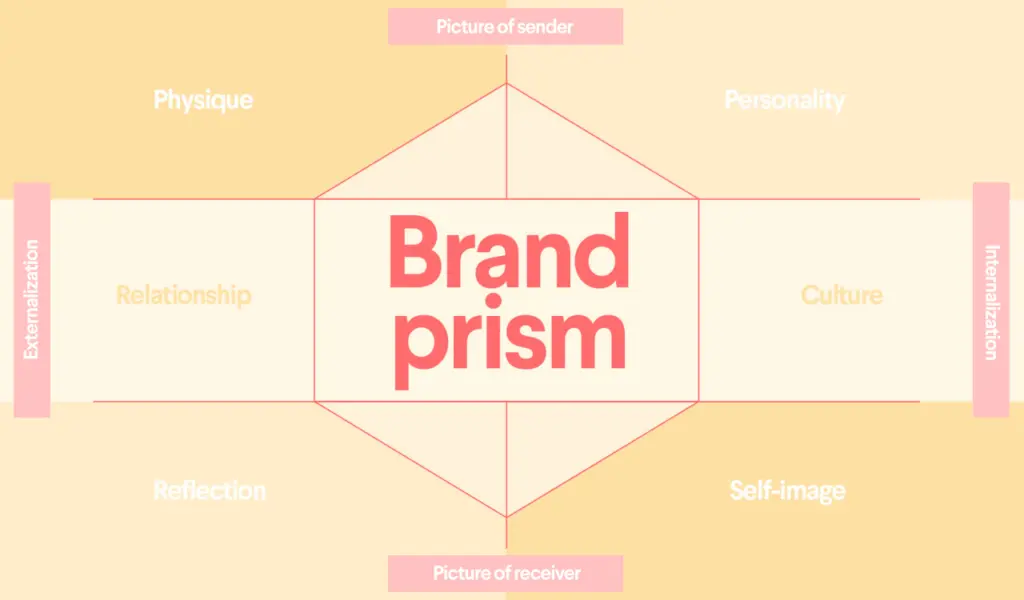
Developed by French branding scholar Jean-Noël Kapferer, the Brand Identity Prism describes brand identity through six interconnected facets:
- Physique
- Personality
- Culture
- Relationship
- Reflection
- Self-image
Together, these facets help businesses move from:
“This is what our logo looks like.”
to:
“This is who our brand is, how it behaves and what it means to customers.”
At Udjat Agency, we use strategic branding frameworks as tools—not as boxes to complete mechanically.
The goal is not to produce a beautiful Brand Identity Prism.
The goal is to build a coherent brand people can recognize, understand and choose.
What Is Kapferer’s Brand Identity Prism?
The Brand Identity Prism is a strategic branding framework developed by Jean-Noël Kapferer to describe the complete identity of a brand.
Instead of defining identity only through visual elements, the framework considers six dimensions covering both:
what the brand expresses
and:
what the customer experiences.
The six facets are:
| Facet | Core Question |
|---|---|
| Physique | What does the brand physically look and feel like? |
| Personality | If the brand were a person, what would it be like? |
| Culture | Which values and principles shape the brand? |
| Relationship | What kind of relationship does the brand create? |
| Reflection | What type of customer does the brand portray? |
| Self-image | How does the customer feel about themselves when using it? |
The strength of the framework comes from the relationship between these dimensions.
A brand is not strong because each box contains an interesting statement.
It is strong when all six facets tell the same underlying story.
The Six Facets of Kapferer’s Brand Identity Prism
The easiest way to understand the model is to study each facet individually.
1. Physique
Physique represents the tangible, recognizable characteristics of the brand.
It answers:
What do people immediately recognize?
This can include:
- Product design.
- Logo.
- Colours.
- Typography.
- Packaging.
- Store design.
- Website.
- Signature visual assets.
- Product form.
- Sound.
- Photography.
- Physical environment.
But physique is deeper than:
Our colour is red.
The strategic question is:
Which physical characteristics consistently express what the brand means?
Brand Physique Example
Imagine a premium Egyptian coffee brand.
Its physique might include:
- Deep earthy colours.
- Minimal premium packaging.
- Strong Arabic typography.
- Egyptian-origin illustrations.
- Matte packaging materials.
- Distinctive coffee aroma.
- Heavy ceramic cups in physical locations.
Together, those signals create recognition.
Questions to Define Brand Physique
Ask:
- What visual elements should customers recognize instantly?
- Which product characteristics define us?
- What should our packaging feel like?
- Which colours are genuinely distinctive?
- Which visual assets should remain consistent?
- What would customers recognize if the logo disappeared?
That final question is especially useful.
A strong visual identity should eventually become recognizable beyond the logo itself.
2. Personality
Personality describes the human character of the brand.
Ask:
If this brand walked into a room as a person, what would they be like?
Possible characteristics include:
- Sophisticated.
- Adventurous.
- Rebellious.
- Calm.
- Intelligent.
- Playful.
- Direct.
- Warm.
- Precise.
- Ambitious.
- Approachable.
Personality influences:
- Tone of voice.
- Advertising.
- Copywriting.
- Social media.
- Customer-service language.
- Photography.
- Campaign ideas.
- Executive communication.
Brand Personality Example
Our hypothetical premium Egyptian coffee brand might be:
Cultured + confident + contemporary + warm
rather than:
Loud + youthful + humorous + chaotic.
Those choices affect almost every communication decision.
Personality Is Not a List of Random Adjectives
A common branding workshop produces something like:
Professional, innovative, friendly, modern, trusted.
Almost every company says this.
That makes the description nearly useless.
A useful personality should help make decisions.
For example:
Confident, never arrogant.
Knowledgeable, never academic.
Warm, never childish.
Premium, never pretentious.
Now the personality can actually guide creative work.
3. Culture
Culture represents the principles, values and worldview underneath the brand.
This is one of the most important parts of Kapferer’s model.
Culture answers:
What does this brand fundamentally believe?
It may be influenced by:
- Country of origin.
- Founder philosophy.
- Company history.
- Internal behaviour.
- Craft tradition.
- Design philosophy.
- Innovation culture.
- Social principles.
- Customer philosophy.
Culture is not simply a page containing:
Integrity
Innovation
Excellence
The more useful question is:
What beliefs actually influence how this company behaves?
Culture Example
Our coffee brand might believe:
Egyptian products can be culturally rooted without looking traditional or nostalgic.
That belief could influence:
- Packaging.
- Store design.
- Collaborations.
- Photography.
- Product naming.
- Communication.
Now culture affects actual decisions.
Brand Culture vs Company Values
These concepts overlap but are not always identical.
Company Values
Often describe how employees should behave.
Brand Culture
Describes the deeper worldview informing what the brand represents externally and internally.
A strong organization tries to align both.
Otherwise customers eventually discover the contradiction.
4. Relationship
Relationship describes the kind of interaction the brand creates between itself and its customers.
Ask:
What role does this brand play in the customer’s life?
Examples could include:
Advisor
Helps customers make better decisions.
Coach
Pushes customers toward improvement.
Companion
Stays beside the customer.
Expert
Provides confidence and specialist knowledge.
Host
Creates comfort and belonging.
Challenger
Encourages the customer to question conventions.
Facilitator
Makes something complicated easier.
Relationship is particularly useful because it moves branding beyond visual identity.
It affects:
- Sales.
- Customer service.
- Website UX.
- CRM.
- Product design.
- Retail.
- Follow-up.
- Loyalty.
Relationship Example
Our coffee brand might define its relationship as:
A knowledgeable host introducing customers to better Egyptian coffee without making specialty coffee intimidating.
Notice how much more useful this is than:
Friendly.
It gives the team something to design around.
5. Reflection
Reflection is one of the most misunderstood elements of the Brand Identity Prism.
Reflection describes:
The image of the typical customer that the brand projects outwardly.
It is not necessarily a demographic profile.
It is the symbolic customer represented by the brand.
For example, a brand might reflect someone who is:
- Independent.
- Successful.
- Creative.
- Adventurous.
- Health-conscious.
- Sophisticated.
- Technologically progressive.
The actual customer base can be much broader.
Reflection is the customer image expressed in brand communication.
Reflection Example
Our coffee brand might reflect:
Urban Egyptians who appreciate design, quality and contemporary local culture.
That does not mean every customer must fit that description exactly.
It describes the symbolic person the brand celebrates.
Reflection Is Not the Same as Target Audience
This distinction matters.
Target Audience
Could be:
Egyptian men and women aged 25–45 in Cairo and Alexandria with middle-to-high disposable income.
Reflection
Could be:
Curious, culturally confident urban people who choose quality intentionally.
The first helps media targeting.
The second helps shape identity.
Both are useful.
But they solve different problems.
6. Self-Image
Self-image describes how customers perceive themselves internally when they choose or use the brand.
Ask:
What does buying this brand allow the customer to say to themselves about who they are?
This is different from Reflection.
Reflection
How the brand portrays its customer externally.
Self-Image
How the customer feels internally.
This distinction is one of the most powerful ideas in Kapferer’s model.
Self-Image Example
The coffee brand’s customer might think:
I have good taste.
or:
I support modern Egyptian creativity.
or:
I know quality when I see it.
The product sells coffee.
The brand can reinforce identity.
Reflection vs Self-Image Explained Simply
Consider a hypothetical premium fitness brand.
Reflection
The outward customer image:
Disciplined, energetic and ambitious people.
Self-Image
The internal feeling:
I am someone who takes my health seriously.
That difference is subtle but important.
Reflection = the mirror other people see.
Self-image = the mirror inside the customer’s head.
Kapferer’s Brand Identity Prism Template
A simple working template looks like this:
| Dimension | Statement |
|---|---|
| Physique | What are our distinctive tangible characteristics? |
| Personality | What human character do we express? |
| Culture | What beliefs and values shape us? |
| Relationship | What relationship do we create with customers? |
| Reflection | What type of person do we portray as our customer? |
| Self-image | How should customers feel about themselves through us? |
The finished answers should be concise.
If each section needs three pages to explain, the strategy may not yet be clear enough.
The Two Axes of the Brand Identity Prism
Kapferer’s model is not merely six independent boxes.
The facets work across broader dimensions.
One important distinction is between:
External Expression
More visible aspects of identity.
Including:
- Physique.
- Relationship.
- Reflection.
Internal Identity
The deeper characteristics underneath the brand.
Including:
- Personality.
- Culture.
- Self-image.
The model can also be interpreted through the relationship between:
the sender—the brand
and:
the receiver—the customer.
This is why the Prism is so valuable.
It forces companies to examine both:
What are we trying to express?
and:
What does that expression mean to the person receiving it?
Why Is the Brand Identity Prism Useful?
Kapferer’s Brand Identity Prism can be useful when:
- Creating a new brand.
- Rebranding.
- Refreshing an identity.
- Repositioning a company.
- Entering a new market.
- Launching a product.
- Creating brand guidelines.
- Building tone of voice.
- Briefing designers.
- Aligning different departments.
- Managing a brand across countries.
- Diagnosing inconsistent branding.
It gives marketing, design and leadership teams a common language.
Using the Prism for a New Brand
For a new company, the sequence might be:
Market Research
↓
Audience
↓
Competitors
↓
Positioning
↓
Brand Identity Prism
↓
Messaging
↓
Visual Identity
↓
Experience
This is much stronger than:
Pick a company name and ask a designer for three logo options.
Identity should follow strategy.
Using the Prism for Rebranding
An established company should not automatically rebuild all six dimensions.
First ask:
Which parts of the existing identity already have valuable equity?
Perhaps customers strongly recognize:
- Colour.
- Product form.
- Founder personality.
- Service relationship.
Throwing these away may destroy valuable memory structures.
A rebranding project should diagnose:
Keep
Strengthen
Change
Remove
Udjat’s Branding Agency in Egypt process begins with research, category, customers, existing equity and positioning before identity design.
Brand Identity Prism Example: Hypothetical Egyptian Coffee Brand
Consider a fictional brand called:
Cairo Roast
Physique
- Warm earth tones.
- Modern Arabic typography.
- Egyptian-origin graphics.
- Minimal packaging.
- Premium coffee presentation.
Personality
- Cultured.
- Curious.
- Confident.
- Warm.
- Contemporary.
Culture
Egyptian creativity can be internationally sophisticated without losing its local character.
Relationship
Knowledgeable host making premium coffee accessible.
Reflection
Contemporary Egyptians who care about quality, culture and design.
Self-Image
I have distinctive taste and confidently support modern local culture.
Now imagine its advertising.
It should probably not suddenly behave like:
CRAZY COFFEE DEAL 🔥🔥🔥 BUY 1 GET 3 FREE!!!!
That would conflict with several dimensions.
The Prism exposes the inconsistency.
Brand Identity Prism Example for a B2B Technology Company
Now imagine a B2B cybersecurity platform.
Physique
- Clean product interface.
- Dark, controlled visual system.
- Data dashboards.
- Precise diagrams.
Personality
- Calm.
- Authoritative.
- Precise.
- Vigilant.
Culture
Security should reduce business uncertainty rather than create more technical complexity.
Relationship
Trusted specialist protecting the customer while helping management understand risk.
Reflection
Responsible, forward-looking business leaders.
Self-Image
I am making a responsible decision that protects the organization.
The emotional role still matters even in B2B.
Executives are people.
They make decisions involving:
- Risk.
- Confidence.
- Identity.
- Professional reputation.
Brand Identity Prism Example for a Luxury Brand
Luxury brands often demonstrate why the Reflection/Self-image distinction matters.
A luxury brand may reflect:
Successful, discerning people.
But customers’ internal self-image might be:
I have reached a level where I can choose exceptional things.
Those are related.
They are not identical.
The symbolic layer helps explain why luxury branding cannot be reduced to product specifications.
How to Create a Brand Identity Prism
A practical Udjat-style process would look like this.
Step 1: Research the Market
Study:
- Category.
- Competitors.
- Cultural context.
- Customer expectations.
- Existing conventions.
Do not define identity in isolation.
Step 2: Research Customers
Understand:
- Motivations.
- Frustrations.
- Language.
- Aspirations.
- Buying behaviour.
- Identity signals.
Udjat’s Market Research Company in Egypt approach can support this stage.
Step 3: Define Positioning
Clarify:
- Customer.
- Category.
- Problem.
- Value.
- Differentiation.
Brand identity without positioning can become decorative.
Step 4: Define Culture
Start inside.
Ask:
Which beliefs genuinely shape this business?
Do not write aspirational values the company cannot demonstrate.
Step 5: Define Personality
Choose characteristics that create useful creative boundaries.
Try:
We are X, but never Y.
For example:
Confident, never arrogant.
This makes personality actionable.
Step 6: Define Relationship
Ask:
Which role should we play in the customer’s life?
Advisor?
Guide?
Partner?
Challenger?
Host?
Step 7: Define Reflection
Describe the symbolic customer your communication celebrates.
Avoid reducing this to:
Men and women aged 18–65.
Demographics are not identity.
Step 8: Define Self-Image
Complete the sentence:
When customers choose us, we want them to feel…
Possible responses:
smarter.
confident.
responsible.
creative.
sophisticated.
secure.
independent.
Step 9: Define Physique
Only now translate strategy into distinctive sensory and visual elements.
That can inform:
- Logo.
- Colours.
- Typography.
- Packaging.
- Photography.
- Digital design.
The visual identity becomes an expression of strategy rather than a separate creative exercise.
Step 10: Test Coherence
Compare every facet.
Does:
Physique match Personality?
Does:
Personality reflect Culture?
Does:
Relationship support Positioning?
Does:
Reflection connect with Self-image?
If not, identify the contradiction.
Coherence is where the model becomes useful.
Brand Identity Prism Workshop Questions
Use these questions in a strategy workshop.
Physique
- What should people recognize immediately?
- Which physical or visual attributes define us?
- What cannot disappear during a redesign?
Personality
- If the brand were a person, how would it speak?
- Which behaviours would feel completely out of character?
- Which three characteristics best describe it?
Culture
- What do we genuinely believe?
- Which principles affect business decisions?
- Where does our worldview come from?
Relationship
- Which role do we play for customers?
- What should interacting with us feel like?
- How should customers describe the relationship?
Reflection
- Who appears to use our brand?
- What symbolic customer do we celebrate?
- What characteristics does that person represent?
Self-Image
- How do customers want to feel?
- What does choosing us say to themselves?
- Which identity does the purchase reinforce?
How to Know if Your Brand Identity Prism Is Weak
Warning signs include:
Generic Language
Innovative, professional and trustworthy.
No Trade-Offs
The brand wants to be:
Premium AND cheapest.
Serious AND hilarious.
Exclusive AND for everyone.
Personality Does Not Affect Behaviour
The adjectives never influence communication.
Culture Is Fictional
Internal reality contradicts stated values.
Reflection Is Just Demographics
Females aged 25–34.
Reflection and Self-Image Are Identical
The team has not understood the difference.
Physique Is Only the Logo
No wider distinctive assets exist.
Every Competitor Could Use the Same Prism
This is the most important test.
Remove the brand name.
Could three competitors claim the exact same six statements?
If yes:
The strategy is probably too generic.
Brand Identity Prism vs Brand Archetypes
Brand archetypes and Kapferer’s Prism are different tools.
Brand Archetype
Primarily helps define symbolic character or recurring personality patterns.
Examples:
- Hero.
- Explorer.
- Sage.
- Creator.
Brand Identity Prism
Defines a broader identity system containing six dimensions.
An archetype may help inform:
Personality
but it does not replace the complete Prism.
Brand Identity Prism vs Brand Positioning
Positioning answers:
Why should a defined customer choose this brand instead of alternatives?
The Brand Identity Prism answers:
Who is this brand?
Positioning is competitive.
Identity is expressive.
They should support one another.
Brand Identity Prism vs Brand Essence
Brand essence is usually a highly compressed expression of the core brand idea.
The Prism is more diagnostic and detailed.
For example:
Brand Essence
Confident Egyptian creativity.
Prism
Explains how that idea becomes:
- Physique.
- Personality.
- Culture.
- Relationship.
- Reflection.
- Self-image.
Essence compresses.
The Prism expands.
Brand Identity Prism vs Brand Guidelines
Brand guidelines explain how teams should apply identity.
They can include:
- Logo.
- Typography.
- Colours.
- Tone.
- Photography.
- Templates.
- Applications.
The Brand Identity Prism sits further upstream.
A useful sequence is:
Research
↓
Positioning
↓
Identity Prism
↓
Verbal Identity
↓
Visual Identity
↓
Brand Guidelines
↓
Implementation
At Udjat, branding is similarly structured from research and positioning through naming, messaging, identity, guidelines and rollout rather than beginning with the logo.
Brand Identity Prism vs Brand Image
This distinction is essential.
Brand Identity
What the company intends the brand to mean.
Brand Image
How people actually perceive the brand.
The Brand Identity Prism primarily helps define identity.
Research then determines whether the market’s image matches that intended identity.
The gap between the two can reveal:
- Weak communication.
- Poor experience.
- Inconsistent branding.
- Incorrect assumptions.
Internal Identity vs External Image
Imagine a company believes:
We are premium.
But customers say:
Expensive and outdated.
The internal identity is not enough.
Brand strategy requires customer evidence.
That is why Udjat connects branding with market and customer research rather than defining identity only through internal workshops.
The Brand Identity Prism and Visual Identity
The Prism can become an excellent creative brief.
Suppose the brand personality is:
Precise + intelligent + restrained
and culture is:
Evidence before hype.
A visual designer now has meaningful strategic direction.
That may influence:
- Grid.
- Typography.
- Motion.
- Photography.
- Colour.
- Information hierarchy.
Without strategy, the brief might simply say:
Make it modern and premium.
That is not enough.
The Brand Identity Prism and Tone of Voice
Personality and culture strongly influence verbal identity.
For example:
Brand Personality
Direct + expert + human.
Tone Principles
Say:
Here’s what the evidence shows.
Avoid:
We are delighted to proudly announce our groundbreaking world-class innovative solution.
The identity becomes operational.
The Brand Identity Prism and Customer Experience
Relationship should influence more than advertising.
If your brand says:
We are your trusted advisor.
but customers experience:
- No response.
- Aggressive sales.
- Hidden pricing.
- Poor support.
the relationship facet is false.
A brand becomes believable through behaviour.
Not merely communication.
The Brand Identity Prism and Rebranding
Before redesigning an existing identity, build two Prisms:
Current Identity Prism
What does the brand actually represent today?
Desired Identity Prism
What should it represent tomorrow?
Then examine the gap.
Possible conclusion:
Physique needs major change.
Personality needs refinement.
Culture should remain.
Relationship needs operational improvement.
This prevents rebranding from becoming:
Change the logo because management is bored.
The Brand Identity Prism for Product Brands
The framework can also support product marketing.
A company may have:
Corporate Brand
One Prism.
Product Brand
A related but distinct Prism.
The identities should not contradict one another.
But they do not need to be identical.
This is particularly useful in:
- SaaS.
- FMCG.
- Automotive.
- Hospitality.
- Technology.
See Udjat’s Product Marketing Agency Egypt framework for the connection between product positioning, messaging and go-to-market strategy.
Brand Identity Prism for Egyptian Brands
Egyptian companies should think carefully about culture.
Local identity does not require:
- Pharaoh icons.
- Pyramids.
- Hieroglyphs.
- Gold everywhere.
Egyptian identity can be expressed through:
- Language.
- Behaviour.
- Humour.
- Hospitality.
- Craft.
- Modern culture.
- Typography.
- Social values.
- Design thinking.
Culture should be strategically relevant rather than decorative.
Local Brand vs Global Brand
Companies entering multiple markets should determine:
Which parts of the Prism are universal?
and:
Which expressions should adapt locally?
For example:
Stable
- Core culture.
- Purpose.
- Central personality.
Adaptable
- Language.
- Examples.
- Influencers.
- Visual contexts.
- Campaign execution.
Global consistency should not mean cultural blindness.
How Udjat Uses Brand Identity Frameworks
At Udjat, the framework should sit inside a wider brand-building process.
Discover
Research:
- Business.
- Customers.
- Category.
- Competitors.
- Culture.
- Existing equity.
Define
Clarify:
- Positioning.
- Value proposition.
- Brand architecture.
- Personality.
- Brand principles.
- Narrative.
Design
Translate strategy into:
- Verbal identity.
- Logo.
- Typography.
- Colour.
- Imagery.
- Graphic language.
- Motion.
Deploy
Apply the brand across:
- Website.
- Social media.
- Sales.
- Packaging.
- Documents.
- Physical spaces.
- Campaigns.
Govern
Create:
- Guidelines.
- Templates.
- Training.
- Decision principles.
This is why Udjat’s Branding Agency in Egypt approach begins with what the brand should mean before deciding how it should look.
Brand Identity Prism Template: Copy and Complete
Use this simplified template:
Physique
Our most distinctive tangible characteristics are:
________________________
Customers should immediately recognize:
________________________
Personality
If our brand were a person, they would be:
________________________
We are:
__________, but never __________.
Culture
We fundamentally believe:
________________________
This belief affects the way we:
________________________
Relationship
The role we play in our customer’s life is:
________________________
Interacting with us should feel:
________________________
Reflection
The customer image our brand celebrates is:
________________________
They are the kind of person who:
________________________
Self-Image
When customers choose us, they should think:
I am ________________________.
They should feel:
________________________
Brand Identity Prism Quality Test
After completing the Prism, score every statement.
| Test | Question |
|---|---|
| Specific | Could a competitor say the same thing? |
| Credible | Can the business actually behave this way? |
| Relevant | Does the customer care? |
| Distinctive | Does this help us stand apart? |
| Consistent | Do all six dimensions support one another? |
| Actionable | Can teams use this to make decisions? |
If a statement fails several tests, rewrite it.
Frequently Asked Questions
What is Kapferer’s Brand Identity Prism?
Kapferer’s Brand Identity Prism is a branding framework developed by Jean-Noël Kapferer that defines brand identity through six interconnected facets: Physique, Personality, Culture, Relationship, Reflection and Self-image.
What are the six elements of Kapferer’s Brand Identity Prism?
The six facets are:
- Physique.
- Personality.
- Culture.
- Relationship.
- Reflection.
- Self-image.
Together, they describe both how the brand expresses itself and how it relates to the customer.
Who created the Brand Identity Prism?
The Brand Identity Prism was developed by French branding scholar Jean-Noël Kapferer as part of his work on strategic brand management.
What does physique mean in the Brand Identity Prism?
Physique describes recognizable tangible characteristics of the brand, including product features, visual assets, packaging and other sensory identifiers.
What does personality mean in Kapferer’s Prism?
Personality describes the human character expressed by the brand through language, communication and behaviour.
What does culture mean in the Brand Identity Prism?
Culture represents the values, principles and worldview underlying the brand.
It can be shaped by the company’s origin, history, founders and organizational philosophy.
What does relationship mean in the Brand Identity Prism?
Relationship describes the role the brand plays in interactions with its customers—for example advisor, partner, coach, expert or host.
What is reflection in Kapferer’s Brand Identity Prism?
Reflection is the symbolic image of the customer portrayed by the brand.
It describes the kind of person the brand appears to celebrate or represent.
What is self-image in Kapferer’s Brand Identity Prism?
Self-image describes how customers perceive themselves internally when using or choosing the brand.
For example:
I am sophisticated.
I am responsible.
I am adventurous.
What is the difference between reflection and self-image?
Reflection is outward-facing:
What kind of person does the brand portray as its customer?
Self-image is inward-facing:
How does choosing the brand make the customer feel about themselves?
Is the Brand Identity Prism the same as a customer persona?
No.
A customer persona describes the customer in greater behavioural and practical detail.
Reflection describes the symbolic customer image communicated by the brand.
Is the Brand Identity Prism a positioning framework?
Not exactly.
Positioning explains why the brand should be chosen within a competitive market.
The Brand Identity Prism explains the brand’s broader identity.
They work well together.
Is the Brand Identity Prism still useful?
Yes.
The model remains useful for new-brand development, rebranding, identity diagnosis and aligning verbal, visual and customer-experience decisions.
Its value comes from forcing teams to think beyond visual design and consider both internal identity and customer meaning.
Can startups use Kapferer’s Brand Identity Prism?
Yes.
Startups can use the framework to clarify identity before creating:
- Naming.
- Messaging.
- Visual identity.
- Website.
- Marketing.
However, the Prism should be informed by actual customer and market research.
Can B2B companies use the Brand Identity Prism?
Yes.
B2B customers still form perceptions involving:
- Trust.
- Risk.
- Expertise.
- Confidence.
- Professional identity.
The six facets can therefore be applied to B2B brands as well as consumer brands.
Can personal brands use Kapferer’s Prism?
Yes, with adaptation.
An executive or expert can define:
- Recognizable presentation.
- Personality.
- Values.
- Audience relationship.
- Reflection.
- Audience self-image.
However, authenticity becomes particularly important.
Can the Brand Identity Prism help with rebranding?
Yes.
One useful method is to compare:
Current Prism
with:
Desired Prism.
The differences reveal which aspects of identity need to change and which should remain.
Does the Brand Identity Prism define logo design?
Not directly.
It provides strategic inputs that can guide visual identity.
The logo is one expression of the broader Physique facet.
Should the visual identity be created before the Brand Identity Prism?
Usually not.
For strategic branding work, it is stronger to establish:
Research → Positioning → Identity → Creative Direction → Visual Design
before finalizing visual assets.
How long should a Brand Identity Prism be?
There is no fixed length.
A useful Prism should generally be concise enough that leadership, marketing, designers and other teams can remember and apply it.
Clarity matters more than volume.
How often should the Brand Identity Prism change?
Strong brand identities should have continuity.
The Prism should not change because of every campaign or trend.
However, it may need review when:
- Market position changes.
- The company changes substantially.
- New audiences become strategically important.
- A merger occurs.
- The brand expands internationally.
- Customer perceptions diverge materially from intended identity.
Can Udjat create a Brand Identity Prism?
Yes.
Kapferer’s Prism can be incorporated into a broader Udjat brand-strategy engagement where it helps clarify the business’s:
- Personality.
- Culture.
- Relationship.
- Customer reflection.
- Self-image.
- Distinctive expression.
The framework would normally sit alongside research, positioning, messaging and visual-identity development rather than being treated as an isolated worksheet.
How does Udjat build brand identity?
Udjat’s branding process connects:
Research
↓
Positioning
↓
Brand Strategy
↓
Verbal Identity
↓
Visual Identity
↓
Guidelines
↓
Rollout
The objective is not simply a new logo.
It is a brand system the organization can use consistently across customer and employee touchpoints.
Conclusion: A Brand Should Mean Something Before It Looks Like Something
One of the most expensive branding mistakes is beginning with:
Which logo do we like?
before answering:
Who are we?
Kapferer’s Brand Identity Prism forces companies to work through that deeper question.
It connects:
What customers recognize
through Physique
with:
how the brand behaves
through Personality
with:
what the organization believes
through Culture
with:
how it treats customers
through Relationship
with:
who customers see represented
through Reflection
and finally:
who customers feel they become
through Self-image.
The six facets are powerful because they cannot work properly in isolation.
The objective is:
coherence.
A brand should look like its personality.
Its personality should reflect its culture.
Its relationship should reinforce its promise.
Its reflected customer should connect with the customer’s desired self-image.
When all six align, brand identity becomes more than:
logo + colour + font.
It becomes a system that guides:
- Design.
- Language.
- Marketing.
- Customer experience.
- Sales.
- Product.
- Culture.
That is why the Brand Identity Prism remains such a useful strategic framework.
And it is also why Udjat’s branding process starts with:
What should this brand mean?
before:
What should it look like?
If your company is creating a new brand, repositioning an existing one or preparing for a rebrand, meet the Udjat Agency branding team.
The strongest identity usually begins with research and strategic clarity—not a mood board.
Sources
- Jean-Noël Kapferer / WARC — Brand Identity Prism: Defines brand identity through the six facets of Physique, Personality, Culture, Relationship, Reflection and Self-image.
- Kapferer, Strategic Brand Management: The Brand Identity Prism forms part of Kapferer’s broader strategic brand-management work and provides a structured framework for understanding brand identity.
- MindTools — Kapferer’s Brand Identity Prism: Practical explanation of the model, including the six identity facets and its application to brand development and diagnosis.
- Udjat Agency — Branding Agency in Egypt: Udjat’s current branding process connects research, positioning, naming, messaging, visual identity, guidelines, customer experience and rollout rather than treating branding as logo design alone.