

Table of contents
- How Do You Create a Marketing Strategy?
- How Do Companies Enter a New Market?
- What Is a Go-to-Market Strategy?
- How Do You Launch a New Product?
- What Is Competitive Analysis?
- How Do Companies Beat Competitors?
- How Do You Create a Marketing Plan?
- What Is Positioning Strategy?
- How Do Companies Dominate a Niche Market?
- What Is Category Creation in Marketing?
- Why Most Business Owners Struggle With Marketing Strategy
- How Smart Companies Think About Strategy in 2026
- Final Thoughts on Marketing Strategy
In business, activity is not strategy.
A company can post more, advertise more, discount more, hire more agencies, attend more events, and still remain strategically weak. Why? Because motion without direction creates noise, not growth.
That is why marketing strategy matters so much.
A real marketing strategy is not a stack of disconnected tactics. It is a system of choices. It decides where we will compete, who we will serve, what position we will own, how we will enter the market, how we will launch, how we will grow, and why customers should choose us over every available alternative.
If we study the history of humanity in business, the pattern is obvious. The great commercial powers did not win because they worked harder in random directions. They won because they chose the right ports, the right routes, the right goods, the right buyers, and the right strategic ground. Venice did not dominate trade by wandering. It dominated by positioning. The same principle governs modern business.
In 2026, the channels are faster, the markets are noisier, and the competition is more visible. That only makes marketing strategy more important, not less.
How Do You Create a Marketing Strategy?
To create a marketing strategy, we begin with clarity, not creativity.
That means answering a small set of uncomfortable but essential questions. Who exactly are we trying to reach? What problem matters enough for them to act? What are they using now instead of us? Why should they care about our solution? What makes our approach different? Which channels actually fit their behavior? And what commercial outcome are we trying to achieve?
Current strategy guides still follow this logic. HubSpot’s marketing strategy framework begins with market research, goals, target audience definition, competitive analysis, messaging, channel selection, KPIs, and content direction.
That sequence matters because strategy is built from diagnosis before action.
Too many businesses reverse the order. They start with channels. They ask whether they should run ads, improve social media, or publish content. Those are tactical questions. Strategy comes earlier. First we decide the battlefield. Then we decide the weapons.
How Do Companies Enter a New Market?
When companies enter a new market, the strongest ones do not begin with optimism. They begin with evidence.
McKinsey’s work on market entry highlights a hard truth: companies often misjudge the odds because of bias, overconfidence, and poor reference points. Their guidance stresses learning from comparable cases and anticipating competitive responses instead of assuming the market will simply welcome the new entrant.
That is strategically sound.
A new market entry should answer a few non-negotiable questions. Is there proven demand? Is the segment underserved or simply crowded? Are incumbents lazy, over-priced, under-positioned, or deeply entrenched? What regulatory, cultural, or distribution barriers exist? What is the fastest believable wedge into the market?
Historically, commercial expansion worked the same way. Great traders did not arrive blindly at foreign ports. They studied local demand, price expectations, power structures, and existing alliances before committing resources.
The companies that enter markets well do not “go broad.” They usually go in through a narrow opening.
What Is a Go-to-Market Strategy?
A go-to-market strategy is the practical plan for bringing a product or service to market and driving demand from the right audience.
HubSpot defines a GTM strategy as a step-by-step plan for bringing a new product to market and driving demand, including identifying a target audience, outlining marketing and sales strategies, and aligning stakeholders around the market problem and solution.
That is a useful definition because it keeps GTM grounded in execution.
A marketing strategy is broader. It defines the long-term game. A go-to-market strategy is narrower. It defines how a specific offer will be introduced and adopted.
A strong GTM strategy usually clarifies the audience, the offer, the positioning, the pricing logic, the distribution path, the sales process, the launch sequence, and the proof points that reduce buyer hesitation. It is where strategic thinking becomes commercial movement.
Think of it as the bridge between idea and traction.
How Do You Launch a New Product?
To launch a new product well, we need more than announcement energy. We need market alignment.
HubSpot’s product launch planning resources emphasize positioning, competitive analysis, market analysis, messaging, execution assets, and coordination across the teams responsible for adoption. McKinsey’s launch research likewise notes that many launches miss targets, while stronger launches rely on cross-team collaboration, market insight, and rigorous planning.
This is why launches fail so often. Businesses confuse publicity with preparedness.
A launch is not a social media post. It is the structured release of a commercial offer into a market that either understands it or does not. If the positioning is weak, the launch struggles. If the category is unclear, the launch struggles. If the team is not aligned, the launch struggles. If the market does not feel urgency, the launch struggles.
In older trade systems, a shipment arriving in port without buyers lined up, pricing clarity, or distribution readiness was not a triumph. It was a gamble. Product launches work the same way.
What Is Competitive Analysis?
Competitive analysis is the disciplined study of how alternatives in the market are positioned, priced, distributed, sold, and perceived.
HubSpot’s 2026 competitor analysis guide describes it as a step-by-step framework for analyzing competitors across the market, including content opportunities, positioning, and user-experience advantages.
That matters because businesses rarely compete in a vacuum. Customers are comparing, even when we wish they were not.
Competitive analysis helps us answer practical questions. Where are competitors strong? Where are they vulnerable? Are they premium and slow, cheap and weak, broad and generic, or narrow and specialized? What claims do they repeat? What parts of the market are they neglecting? Where do customers seem dissatisfied?
The purpose is not imitation. It is strategic contrast.
The best generals in history did not study rivals in order to become copies of them. They studied them to identify the ground on which they could win.
How Do Companies Beat Competitors?
Companies beat competitors by becoming more relevant, more differentiated, and harder to replace.
That sounds simple because it is simple. It is just not easy.
Some firms try to beat competitors through price alone. That is often the weakest path unless the business is structurally built for it. Some compete on speed. Some on specialization. Some on convenience. Some on trust. Some on distribution. Some on experience. Some on category definition itself.
McKinsey’s strategy work and classic HBR strategy thinking both point toward the same broad principle: high performance comes less from random effort and more from coherent choices about where and how to compete.
The companies that beat competitors usually do not try to match every rival on every variable. They choose a more favorable game.
That is strategy.
How Do You Create a Marketing Plan?
A marketing plan is the operational expression of the strategy.
If strategy decides the direction, the marketing plan defines the actions, sequencing, budget priorities, timelines, messaging themes, channels, campaigns, and measurement points required to make that direction real.
HubSpot’s GTM and strategy resources frame this clearly: research, positioning, audience, channels, messaging, and measurement should be translated into execution with clear ownership and performance tracking.
A weak marketing plan is a list of activities. A strong marketing plan is a system of priorities.
That distinction matters because many businesses confuse calendars with plans. A content calendar is not a strategy. An ad budget is not a plan. A quarterly promotion sheet is not a growth system.
A real plan answers: what are we doing, for whom, why this, why now, how much, through which channels, with which message, measured by which outcomes?
What Is Positioning Strategy?
Positioning strategy is the deliberate effort to occupy a clear, differentiated place in the mind of the customer.
It answers one crucial question: when the customer thinks about this category, what should they think about us?
That answer must be sharper than “quality” or “innovation” or “excellent service,” because every competitor claims those things. Positioning becomes useful only when it creates contrast.
A brand can position around affordability, authority, speed, elegance, specialization, simplicity, premium results, local trust, founder expertise, or category focus. But it cannot own all of them at once. The mind rejects ambiguity.
This is why positioning is not decoration. It is a strategic weapon.
The strongest businesses in history were remembered for something specific. Their name became linked to a trait, a route, a quality standard, a region, or a trading advantage. Positioning works the same way in modern markets.
How Do Companies Dominate a Niche Market?
Companies dominate a niche market by becoming the obvious answer for a very specific group with a very specific problem.
Most firms fail here because they abandon the niche too early. They get nervous about seeming too narrow, so they broaden the message, dilute the offer, and weaken their advantage before they have fully owned the first segment.
The businesses that dominate niches usually do the opposite. They go deeper. They speak the customer’s exact language. They solve edge-case frustrations that broad competitors ignore. They build more trust inside that niche than anyone else. Over time, that focus turns into authority.
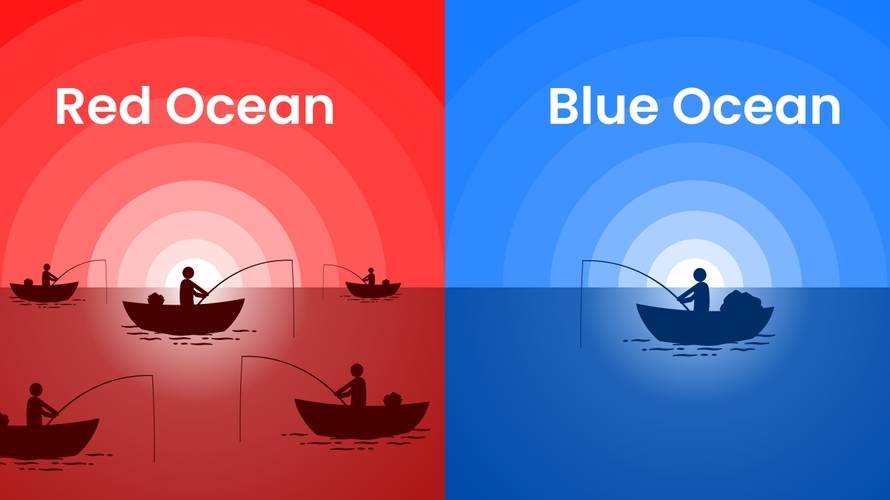
HBR’s classic “Blue Ocean Strategy” argues that the real opportunity often lies in creating uncontested space instead of fighting endlessly in overcrowded categories. That idea is highly relevant here. A niche is often the first form of uncontested or under-contested ground.
The companies that dominate a niche are not trying to be interesting to everyone. They are trying to be indispensable to someone.
What Is Category Creation in Marketing?
Category creation in marketing is the act of defining a new market category, or reframing an existing one, so the business becomes associated with that new territory.
This is one of the most powerful strategic moves available because categories shape perception before feature comparison even begins. If the market accepts the category, the company that defined it often enjoys disproportionate mindshare.
Modern strategy thinking still supports this. McKinsey’s work on future arenas of competition notes that companies can achieve rapid growth by launching novel categories of products or services rather than merely fighting for share inside old ones. HBR’s Blue Ocean logic points in the same direction: create new market space instead of competing head-on in crowded waters.
Category creation is not just naming. It is narrative, education, contrast, and repeated framing.
A company says, in effect: the old way of understanding this problem is incomplete, and here is a better way to think about it.
That is how new categories begin.
Why Most Business Owners Struggle With Marketing Strategy
Most owners struggle with marketing strategy because tactics feel easier than choices.
It is easier to ask which platform to advertise on than to decide which customer to ignore. It is easier to redesign a website than to sharpen a position. It is easier to talk about brand awareness than to define the real wedge into a market.
But strategy is built on trade-offs.
That is why it feels difficult. Every good strategic choice excludes other choices. Every position leaves some people out. Every niche focus narrows the message. Every market entry forces prioritization.
And that is exactly why it works.
How Smart Companies Think About Strategy in 2026
The smartest companies in 2026 still follow enduring principles.
They research first. They define the market precisely. They build a go-to-market strategy around a real problem. They launch with clarity, not hype. They study competitors without becoming copies. They translate strategy into a real marketing plan. They position around contrast. They dominate niches before broadening. And where possible, they shape or create categories instead of begging for attention inside crowded ones. Current strategy frameworks from HubSpot, McKinsey, and HBR continue to reflect those same foundational ideas, even when the channels and terminology evolve.
That is the lesson.
The tools change. The platforms change. The principles of strategic competition do not.
Final Thoughts on Marketing Strategy
When we strip away the jargon, marketing strategy is the discipline of choosing where to compete, how to win, and how to make that choice visible to the market.
It is how companies enter new markets without wandering. It is what gives a go-to-market strategy its structure. It is what turns a product launch from noise into traction. It is why competitive analysis matters. It is how companies beat competitors without racing to the bottom. It is what makes a marketing plan useful instead of decorative. It is the foundation of positioning strategy. It is how niche domination begins. And at its highest level, it is how category creation becomes possible.
That is why business owners ask about strategy so often.
Because deep down, they already know the truth.
Tactics can create movement.
Only strategy creates advantage.