

Table of contents
- What Is the Ansoff Matrix?
- The Ansoff Matrix Explained in One Table
- Why Business Owners Use the Ansoff Matrix
- 1. Market Penetration: Grow Within Your Existing Market
- 2. Market Development: Take Your Existing Offer Somewhere New
- 3. Product Development: Create a New Offer for a Familiar Market
- 4. Diversification: Enter a New Market With a New Offer
- Which Ansoff Matrix Strategy Is the Riskiest?
- One Business, Four Ansoff Matrix Examples
- How to Use the Ansoff Matrix Step by Step
- A Numerical Example: Revenue Growth Versus Contribution
- Ansoff Matrix Versus STP Marketing
- Common Ansoff Matrix Mistakes
- A Practical Ansoff Matrix Workshop
- Frequently Asked Questions
- What Is the Ansoff Matrix in Simple Words?
- What Are the Four Ansoff Matrix Strategies?
- Who Created the Ansoff Matrix?
- Does Market Penetration Only Mean Selling to Existing Customers?
- Does Market Development Always Mean Entering Another Country?
- Can Service Businesses Use the Ansoff Matrix?
- Is Diversification Always the Wrong Choice?
- How Can Udjat Agency Help?
- Choose the Growth You Can Explain
- Sources
Your business wants to grow. The team has ideas.
Open in another city. Launch a new product. Increase advertising. Start selling to companies instead of consumers.
Those ideas can sound equally attractive in a meeting. They create very different demands once you start paying for them.
The Ansoff Matrix helps you organise growth options around two questions: are you changing the product, the market, or both?
For founders in Egypt and the UAE, it provides a useful starting point before committing to expansion. It forces the discussion beyond “we need more sales” and towards the assumptions each opportunity depends on.
What Is the Ansoff Matrix?
The Ansoff Matrix is a strategic planning framework that classifies growth opportunities by whether a business is selling existing or new products into existing or new markets.
The combinations produce four strategies:
- Market penetration.
- Market development.
- Product development.
- Diversification.
It is also known as the product-market growth matrix or product-market expansion grid.

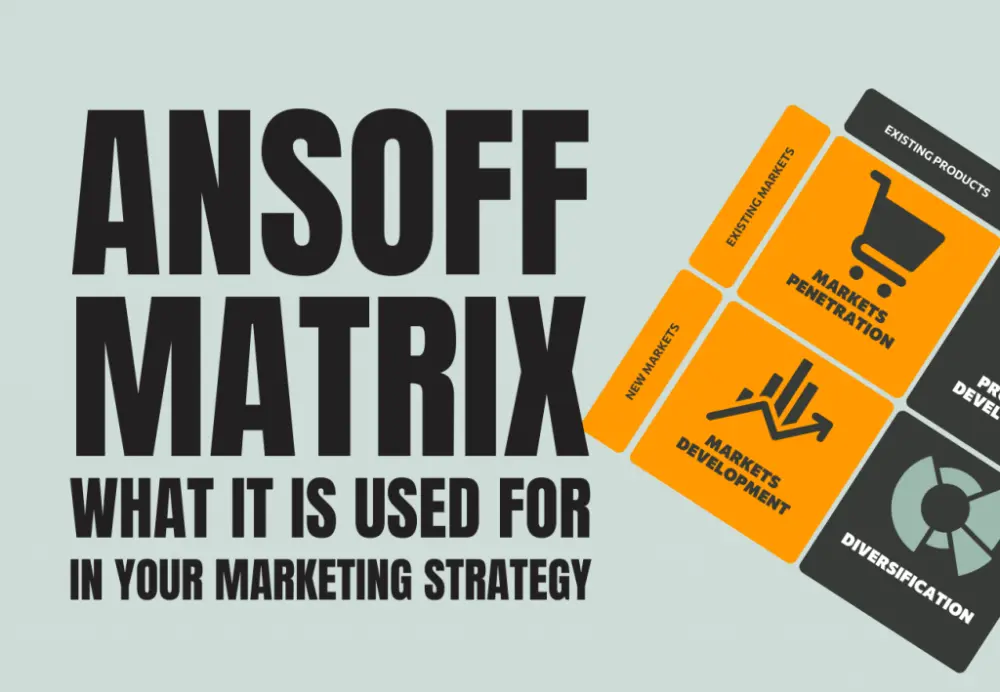
The framework is associated with H. Igor Ansoff, whose article “Strategies for Diversification” appeared in Harvard Business Review in 1957.
Use it to identify the kind of growth you are considering. Then investigate whether that opportunity is desirable and achievable.
A position in the grid is a classification, not an investment recommendation.
The Ansoff Matrix Explained in One Table
| Market / Product | Existing products | New products |
|---|---|---|
| Existing markets | Market penetration: grow sales of the current offer in the current market | Product development: introduce a new offer to a market you already serve |
| New markets | Market development: take the current offer to a new market | Diversification: introduce a new offer to a new market |
“Product” can include a service, subscription, software platform, or physical item.
A new market can mean a new customer group, geography, or relevant use case. It does not necessarily mean another country.
Define those terms for your business before placing an opportunity in the table. Otherwise, different managers may classify the same idea differently.
Why Business Owners Use the Ansoff Matrix
Growth planning becomes easier when the team can distinguish what it knows from what it needs to learn.
Consider a hypothetical Egyptian software company.
Selling more subscriptions to the customer group it already serves involves one set of questions. Selling the same platform to a new industry introduces another. Developing a separate product for an unfamiliar buyer introduces more.
The Ansoff Matrix helps you identify those differences and ask:
- What demand have we already demonstrated?
- What capabilities can we reuse?
- Which assumptions remain untested?
- What new costs or responsibilities appear?
- What evidence should we require before expanding?
Oregon State University’s strategy text treats the matrix as a high-level growth-direction tool. No single strategy suits every company at every time.
That is a useful boundary. Your choice needs more than a familiar framework.
1. Market Penetration: Grow Within Your Existing Market
Market penetration means increasing sales of existing products in an existing market.
It can involve acquiring additional customers from the same market, encouraging suitable repeat purchases, improving conversion, or strengthening distribution within that market.
Existing market does not mean only existing customers.
A business can win customers it has never served while remaining in its current market.
Market Penetration Example
Imagine a hypothetical homeware store serving households in Alexandria.
It keeps its current product range and customer focus but improves product information, ordering clarity, and follow-up for customers who requested information.
Its intention is to win more purchases within the market it already serves.
That is market penetration.
The strategic direction comes first. The appropriate tactics depend on where demand or conversion is constrained.
Questions to Ask Before Increasing Spend
Review the current journey:
- Can suitable buyers understand the offer?
- Are enquiries being answered?
- Is stock available?
- Are delivery conditions clear?
- Do purchasers have reasons to return?
- Where are potential customers choosing alternatives?
More advertising may be appropriate. It may also expose a fulfilment or conversion problem to more people.
Udjat’s performance marketing services can support acquisition and measurement around a clearly defined commercial objective.
Familiar Does Not Mean Risk-Free
AQA describes market penetration as less risky in some respects because the product and market are familiar. It also stresses that demand must exist.
Competition, weak margins, limited capacity, or saturation can still make a penetration initiative unattractive.
Review the actual opportunity. Do not assume this quadrant deserves investment simply because it involves fewer new elements.
2. Market Development: Take Your Existing Offer Somewhere New
Market development means selling existing products to a new market.
The product remains substantially the same. The customer group or market context changes.
This might involve entering another city, another country, a new industry, or a distinct buyer segment.
Market Development Example: Egypt to the UAE
Suppose a hypothetical Egyptian company provides inventory software to independent retailers.
It considers selling that same core platform to comparable retailers in the UAE.
That is geographic market development.
The team should investigate local purchasing requirements, alternatives, onboarding expectations, service coverage, and necessary product adaptations.
An enquiry from a new country is evidence of interest. It does not establish repeatable demand or viable delivery.
A New Market Can Be Closer Than You Think
A consumer-focused cleaning company might explore supplying its existing cleaning service to small offices.
The geography may remain unchanged, but the buying group and purchasing process could be meaningfully different.
Define the new segment and investigate whether the existing service genuinely fits it.
Changing an advertising audience alone is not enough to establish a strategic move into a new market.
Research Before You Replicate
For each proposed market, ask:
- Who would buy?
- What requirement would the current offer address?
- Which alternatives are available?
- What must change in pricing, support, or distribution?
- Can you serve customers at acceptable economics?
- What would a manageable pilot look like?
Udjat’s market research services can help assess customer needs and competitive conditions before expanding.
3. Product Development: Create a New Offer for a Familiar Market
Product development means introducing a new or meaningfully improved product to a market the business already serves.
You may understand the customers, but you still need evidence that they value the proposed offer.
An existing customer relationship gives you access to feedback. It does not guarantee adoption.
Product Development Example
Consider a hypothetical company selling enquiry-management software to small service businesses.
Its customers repeatedly describe difficulty coordinating appointments. The company investigates a separately priced booking product for that same customer market.
This is product development.
Before building, the team should establish what customers currently use, what is missing, and whether the proposed solution deserves a place in their workflow.
Product Development Is More Than Adding Features
A routine bug fix or minor visual improvement need not represent a separate growth strategy.
Assess whether the change creates a meaningful new offering, benefit, or purchasing decision.
The purpose of the Ansoff Matrix is strategic clarity. Classifying every small release as a new growth initiative can obscure that purpose.
Test the Purchase Decision
Ask prospective buyers:
- What would this replace?
- What would make implementation worthwhile?
- Who would approve the purchase?
- Which capabilities are essential?
- What ongoing support would be expected?
Where practical, test a prototype or limited pilot.
Positive comments are useful feedback. A credible buying commitment gives you different evidence.
Watch for Product Cannibalisation
A new offer may attract additional demand, replace purchases of your existing offer, or do both.
That replacement can be intentional. But measure the effect on the combined business.
Track what customers would otherwise have purchased, alongside development, support, and delivery costs.
More sales of the new product do not automatically mean more profitable growth.
4. Diversification: Enter a New Market With a New Offer
Diversification means introducing a new product into a new market.
Both dimensions change relative to the business being analysed.
For example, a hypothetical B2B software provider entering consumer food retail would face a new offer, buyer, and operating model.
That is a very different commitment from selling more software subscriptions.
Related and Unrelated Diversification
Related diversification shares meaningful capabilities or connections with the existing business.
Unrelated diversification has less strategic overlap.
Oregon State University’s strategy text uses Honda’s expansion from motorcycles into automobiles as an example of applying engine-building capabilities across related businesses.
The practical question is which capabilities transfer, and how much advantage they create.
“Both businesses need marketing” is too broad to establish a convincing strategic fit.
Three Questions Worth Borrowing
The Oregon State text summarises three tests for diversification:
- Attractiveness: Is the destination industry commercially attractive?
- Cost of entry: Can the opportunity justify the cost of entering?
- Better off: Does combining the activities create a meaningful advantage?
These complement the Ansoff Matrix. They do not emerge automatically from drawing the grid.
Diversification Has Two Different Risk Questions
Entering unfamiliar products and markets introduces execution uncertainty.
Successful diversification may also reduce dependence on a single existing activity.
Those statements can both be true.
A new business can spread revenue exposure while demanding skills the organisation does not yet possess. Evaluate both the proposed venture and the wider business.
Which Ansoff Matrix Strategy Is the Riskiest?
Diversification generally introduces the most unfamiliar elements because both the product and market are new.
Market penetration generally involves more familiarity.
But the matrix provides no universal probability of success, failure rate, or budget allocation for the four quadrants.
Actual risk depends on demand, competition, capabilities, commitments, and the size of the proposed initiative.
A tightly limited diversification experiment may expose less capital than a major expansion campaign in a declining familiar market.
Use novelty to identify questions. Use evidence to assess the specific decision.
One Business, Four Ansoff Matrix Examples
The following examples describe a hypothetical Egyptian furniture business.
| Strategy | Possible initiative | Key uncertainty to investigate |
|---|---|---|
| Market penetration | Sell more of the existing household furniture range to its current customer market | Is there reachable demand at sustainable economics? |
| Market development | Sell that range to a distinct customer segment in a new geography | Does the offer fit local needs and delivery conditions? |
| Product development | Introduce a new storage range for its current household market | Will customers buy the new range? |
| Diversification | Launch a separate office-space planning service for corporate buyers | Can the company develop and sell the new service to a new market? |
These classifications depend on the starting point.
If the company already provides office planning to businesses, the fourth initiative would no longer represent the same diversification move.
Always record the current product and current market alongside the proposal.
How to Use the Ansoff Matrix Step by Step
Step 1: Establish Your Starting Point
Define the relevant business unit, product, customer group, and geography.
Avoid analysing a large company as though every division has the same starting position.
Step 2: Define What Growth Means
Specify the outcome and timeframe.
Revenue, contribution, recurring customers, and market share are different measures. A revenue increase achieved through heavy discounts may not satisfy a profitability objective.
Use a target the team can measure consistently.
Step 3: Generate Options Across the Grid
Write a small number of plausible opportunities in each quadrant.
You do not need to invest in every category. Exploring alternatives helps you avoid treating the first suggestion as the only route available.
Step 4: Record Evidence and Gaps
Separate customer records, research findings, estimates, and assumptions.
For each option, explain what you know and what still needs validation.
Step 5: Assess Delivery and Economics
Review the people, systems, capacity, costs, and commercial conditions required.
An attractive customer problem can still be unsuitable for your business to solve.
Step 6: Choose a Limited Test
Define the assumption to test, a budget, an owner, a timeframe, and the evidence needed to continue.
A test should be small enough to control while still producing useful information.
Step 7: Review Before Scaling
Compare results with the decision criteria you set.
Proceed, revise, or stop based on the findings. Avoid changing the criteria simply to justify the project.
Udjat’s marketing strategy services can connect growth-direction choices with targeting, positioning, channel priorities, and measurement.
A Numerical Example: Revenue Growth Versus Contribution
These figures are hypothetical, not a client result or industry benchmark.
Suppose an existing offer generates EGP 1,000 per order, with EGP 600 in variable costs before acquisition.
Contribution before acquisition is therefore EGP 400 per order.
A campaign creates 100 additional orders and costs EGP 30,000.
| Measure | Calculation | Result |
|---|---|---|
| Additional revenue | 100 × EGP 1,000 | EGP 100,000 |
| Variable costs | 100 × EGP 600 | EGP 60,000 |
| Contribution before campaign cost | EGP 100,000 − EGP 60,000 | EGP 40,000 |
| Contribution after campaign cost | EGP 40,000 − EGP 30,000 | EGP 10,000 |
If campaign cost rises to EGP 45,000, the same additional revenue produces negative EGP 5,000 contribution after campaign cost.
These figures exclude fixed costs and other omitted expenses, so they do not establish total business profit.
The lesson is practical: classify the growth initiative, then evaluate its economics. The Ansoff Matrix cannot perform that calculation for you.
Ansoff Matrix Versus STP Marketing
The frameworks support different decisions.
| Framework | Main purpose | Useful question |
|---|---|---|
| Ansoff Matrix | Organise product-market growth directions | Where could growth come from? |
| STP marketing | Segment customers, select targets, and define positioning | Whom will we serve, and why should they choose us? |
| SWOT | Organise strengths, weaknesses, opportunities, and threats | Which internal and external factors matter? |
| Marketing mix | Shape product, price, place, and promotion | How will we deliver the chosen offer? |
For example, Ansoff may classify an initiative as market development. STP then helps define which customers within that new market you want to serve.
The frameworks can be used iteratively. Research may reveal that the offer requires more substantial development than originally expected.
Update the classification when the underlying plan changes.
Common Ansoff Matrix Mistakes
Treating Expansion as a Cure for an Unclear Offer
A new market can introduce additional complexity.
Investigate why the existing offer struggles before assuming a different geography will solve the problem.
Equating a New Channel With a New Market
An online store selling the same products to the same customer group may remain a market-penetration initiative.
A channel can enable market development when it reaches a meaningfully new group. Look at the customers reached, not just the technology used.
Launching Before Defining the Buyer
A product-development idea still needs a clear purchasing situation and customer requirement.
Use research to distinguish a desirable capability from an offer customers will fund.
Ignoring Capacity
If the initiative works, can you fulfil the demand?
Review support, stock, onboarding, and delivery before increasing commitments.
Mistaking a Score for Evidence
A scorecard can organise judgement. It cannot turn weak assumptions into reliable findings.
Record the reason and confidence level behind each score.
A Practical Ansoff Matrix Workshop
Bring together people responsible for customers, sales, marketing, operations, and commercial planning.
Work through this sequence:
- Define the current offer and market.
- State the growth objective.
- List plausible opportunities.
- Classify them in the matrix.
- Identify the assumptions behind each.
- Compare evidence, requirements, and economics.
- Choose one priority for further investigation.
- Assign the next action and review date.
The useful output is a documented decision and test plan.
A completed four-box slide is only the beginning.
Frequently Asked Questions
What Is the Ansoff Matrix in Simple Words?
It is a tool that helps a business consider growth through existing or new products and existing or new markets.
What Are the Four Ansoff Matrix Strategies?
Market penetration, market development, product development, and diversification.
Who Created the Ansoff Matrix?
The framework is associated with H. Igor Ansoff and his 1957 work on product-market growth strategies.
Does Market Penetration Only Mean Selling to Existing Customers?
No. It can include winning new customers within the market the business already serves.
Does Market Development Always Mean Entering Another Country?
No. It can involve a distinct customer segment, geography, or relevant use case for the existing offer.
Can Service Businesses Use the Ansoff Matrix?
Yes. Treat the service as the product and define the market it serves. A new service for a current market is product development.
Is Diversification Always the Wrong Choice?
No. It can be appropriate when the opportunity, capabilities, and economics support it. The presence of more unfamiliar elements makes investigation important.
How Can Udjat Agency Help?
Udjat can support market research, marketing strategy, and campaign execution around a defined growth opportunity, with measurement appropriate to the initiative.
Choose the Growth You Can Explain
The Ansoff Matrix makes you specify what is changing.
Are you seeking more demand for the current offer? Taking it to a new market? Developing something new? Changing both?
Once that is clear, identify the evidence, capability, and economics the decision depends on.
A credible growth plan should explain why buyers will choose the offer and how your business will deliver it.
This guide was prepared by the team at Udjat Agency. Discuss your Ansoff Matrix growth options with Udjat to connect the strategic choice with research and practical execution.
Sources
- AQA — Teaching Guide: Ansoff Matrix Model: strategy classifications and risk considerations. Teaching guide: Ansoff matrix model
- OpenStax, Rice University — The Role of Marketing in the Strategic Planning Process: product-market growth strategies. OpenStax
- Oregon State University — Concentration Strategies: growth-direction boundaries, strategy definitions, and the reference to Ansoff’s 1957 article. Strategic Management
- Oregon State University — Diversification Strategies: related and unrelated diversification, Honda example, and diversification tests. Strategic Management
- OpenStax, Rice University — Product Positioning: STP and positioning as complementary marketing decisions.