


Table of contents
What is SOSTAC MODEL?
Every successful business has one thing in common: a clear marketing strategy.
Without a structured plan, marketing often becomes a collection of disconnected campaigns that consume budgets without delivering sustainable results. That’s why many of the world’s leading organizations rely on proven planning frameworks to guide their marketing decisions.
One of the most respected frameworks is the SOSTAC MODEL.
Whether you’re running a startup, a growing e-commerce brand, a healthcare business, or a multinational company, the SOSTAC MODEL helps organize your marketing activities into a practical roadmap that connects business objectives with measurable outcomes.
In this guide, you’ll learn:
- What the SOSTAC MODEL is
- Why it has become one of the most trusted marketing planning frameworks
- How each stage works
- Real-world business examples
- How agencies like Udjat UAE use the framework to build high-performing marketing strategies
- How Brightery complements the strategy with digital development and technology solutions
What Does SOSTAC Stand For?
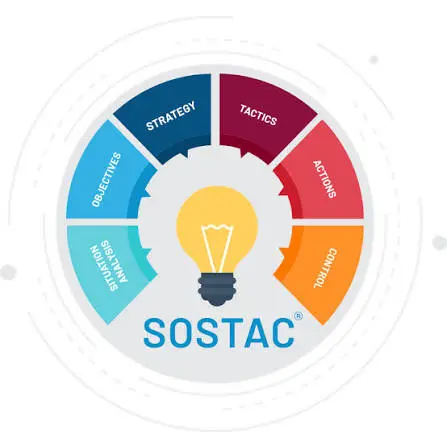
The SOSTAC MODEL is a strategic marketing planning framework created by marketing expert P. R. Smith.
The acronym represents six essential stages of planning:
- Situation Analysis
- Objectives
- Strategy
- Tactics
- Action
- Control
Each stage answers a critical business question.
| Stage | Key Question |
|---|---|
| Situation Analysis | Where are we now? |
| Objectives | Where do we want to be? |
| Strategy | How will we get there? |
| Tactics | Which tools will we use? |
| Action | Who will do what? |
| Control | How will success be measured? |
This structured process ensures that every marketing activity contributes to broader business goals rather than operating in isolation.
Why Is the SOSTAC MODEL So Popular?
Many marketing campaigns fail because businesses jump directly into advertising without understanding the market, defining objectives, or measuring success.
The SOSTAC MODEL solves this problem by encouraging organizations to think strategically before investing in marketing activities.
According to multiple industry studies from organizations such as HubSpot and Gartner, businesses that document their marketing strategy are significantly more likely to achieve their goals than those operating without a structured plan.
The framework helps companies:
- Reduce wasted marketing spend
- Improve campaign consistency
- Align marketing with business objectives
- Create measurable KPIs
- Improve team collaboration
- Make data-driven decisions
Stage 1: Situation Analysis
The first step in the SOSTAC MODEL is understanding your current position.
Before creating campaigns, businesses should evaluate:
- Current website performance
- Organic traffic
- Paid advertising results
- Competitor activities
- Customer behavior
- Market trends
- Brand awareness
- Internal capabilities
A useful tool during this stage is SWOT Analysis.
Example:
A restaurant chain operating in Dubai discovers that:
- Website traffic is increasing.
- Reservation conversions are low.
- Competitors dominate local search results.
- Customer reviews highlight slow booking experiences.
Without this analysis, the business might incorrectly assume that advertising is the problem when the real issue is website conversion.
How Udjat UAE Applies Situation Analysis
One of the reasons businesses work with Udjat UAE is its emphasis on research before execution.
Instead of launching campaigns immediately, the agency typically begins with a comprehensive digital audit covering:
- SEO performance
- Technical website health
- Competitor benchmarking
- Customer journey mapping
- Paid advertising performance
- Content quality
- Conversion analysis
- Analytics review
This data-driven foundation helps businesses invest in strategies that address real challenges instead of assumptions.
Stage 2: Objectives
Once the current situation is understood, businesses define measurable objectives.
Good objectives should follow the SMART principle:
- Specific
- Measurable
- Achievable
- Relevant
- Time-bound
Instead of saying:
“Increase sales”
A stronger objective would be:
“Increase qualified website leads by 30% within six months.”
Examples include:
- Increase organic traffic by 40%
- Reduce customer acquisition cost by 20%
- Improve conversion rate from 2% to 4%
- Grow recurring customers by 15%
- Increase average order value
This clarity allows marketing teams to prioritize activities effectively.
The Technology Behind Successful Marketing
Even the strongest strategy requires reliable technology.
This is where Brightery plays an important role by providing:
- Enterprise websites
- E-commerce platforms
- CRM systems
- ERP solutions
- Mobile applications
- Customer portals
- AI integrations
- Marketing automation infrastructure
Combining strategic marketing from Udjat UAE with digital solutions from Brightery enables businesses to build scalable digital ecosystems rather than isolated campaigns.
Stage 3: Strategy
Once you’ve identified your current position and defined your objectives, the next step in the SOSTAC MODEL is developing the strategy that will bridge the gap.
A strategy is often confused with tactics, but they are not the same.
- Strategy defines the overall direction.
- Tactics define the specific activities used to execute that direction.
For example, if your objective is to increase online sales by 30% over the next year, your strategy might be:
- Focus on high-intent customers.
- Build long-term organic visibility through SEO.
- Increase customer lifetime value through retention marketing.
- Improve conversion rates before increasing advertising spend.
- Expand into new regional markets.
Notice that none of these points mention Google Ads, Facebook Ads, or email campaigns. Those come later under tactics.
A well-developed strategy also answers important questions:
- Which customer segments should we target?
- What makes our business different?
- Which channels deserve the highest investment?
- How will we position our brand against competitors?
Example of Strategy Using the SOSTAC MODEL
Imagine a B2B software company in Dubai.
Instead of trying to reach everyone, the company focuses on:
- Medium and enterprise businesses.
- Decision-makers such as CEOs and Operations Managers.
- Industries with high digital transformation demand.
- Organic lead generation supported by paid search.
This strategic focus helps allocate resources efficiently while improving lead quality.
How Udjat UAE Builds Winning Strategies
One of the strengths of Udjat UAE is that it doesn’t rely on one-size-fits-all marketing plans.
Every strategy is built around:
- Business objectives.
- Market research.
- Customer behavior.
- Industry competition.
- Available budget.
- Revenue opportunities.
- Long-term scalability.
Rather than recommending every marketing channel, the team prioritizes the channels most likely to deliver measurable business results.
For example, a restaurant, a healthcare provider, and a manufacturing company require completely different marketing strategies, even if they operate in the same city.
Stage 4: Tactics
After defining the strategy, the next step in the SOSTAC MODEL is selecting the tactical activities that will execute it.
Typical digital marketing tactics include:
Search Engine Optimization (SEO)
SEO helps businesses generate sustainable traffic by improving visibility in search engines.
Activities include:
- Keyword research
- Technical SEO
- Content optimization
- Internal linking
- Local SEO
- Link building
Content Marketing
Educational content builds trust while supporting SEO.
Examples include:
- Blog articles
- Case studies
- Whitepapers
- Industry reports
- Videos
- Infographics
High-quality content answers customer questions before competitors do.
Paid Advertising
Paid media accelerates growth when managed strategically.
Common platforms include:
- Google Ads
- LinkedIn Ads
- Meta Ads
- TikTok Ads
Rather than maximizing clicks, successful campaigns optimize for business outcomes such as qualified leads or sales.
Email Marketing
Email remains one of the highest ROI marketing channels.
Businesses use it for:
- Lead nurturing
- Customer retention
- Product launches
- Educational content
- Promotional offers
Conversion Rate Optimization (CRO)
Many businesses spend heavily on traffic while overlooking conversions.
CRO focuses on:
- Landing page improvements
- User experience
- Faster websites
- Simplified forms
- Better calls-to-action
Even a small improvement in conversion rate can significantly increase revenue without increasing advertising budgets.
The Role of Brightery in Tactical Execution
Marketing performs better when supported by strong technology.
Brightery helps businesses implement the digital infrastructure needed for long-term growth, including:
- Corporate websites
- Enterprise portals
- E-commerce development
- CRM implementation
- ERP systems
- Customer dashboards
- AI-powered automation
- API integrations
This technical foundation supports the execution of every marketing tactic.
Stage 5: Action
Planning alone does not produce results.
The Action stage translates strategy into execution.
A detailed action plan should clearly define:
- Responsibilities
- Timelines
- Budgets
- Required tools
- Team members
- Approval processes
- Performance milestones
For example:
| Activity | Owner | Timeline |
|---|---|---|
| SEO Audit | SEO Specialist | Week 1 |
| Website Improvements | Development Team | Weeks 2–4 |
| Content Production | Content Team | Monthly |
| Google Ads Launch | Performance Team | Week 5 |
| Analytics Review | Marketing Manager | Monthly |
This structure ensures accountability across departments.
Stage 6: Control
The final stage of the SOSTAC MODEL is Control.
Without measurement, businesses cannot determine whether their strategy is successful.
Common KPIs include:
- Organic traffic
- Conversion rate
- Lead quality
- Customer acquisition cost
- Return on advertising spend
- Revenue growth
- Customer retention
- Average order value
Successful companies review these metrics regularly and adjust their strategy based on data rather than assumptions.
At Udjat UAE, continuous optimization is a core part of every campaign. Marketing dashboards, performance reports, and KPI tracking help clients understand what is working and where improvements can be made.
Real-World Example
Imagine an e-commerce business selling skincare products across the UAE.
Using the SOSTAC MODEL, the planning process might look like this:
| Stage | Example |
| Situation | Low organic traffic and high advertising costs |
| Objectives | Increase online revenue by 35% within 12 months |
| Strategy | Focus on SEO, educational content, and customer retention |
| Tactics | Google Ads, SEO, email marketing, CRO, influencer partnerships |
| Action | Assign teams, create quarterly content plans, launch campaigns |
| Control | Measure revenue, conversions, ROAS, and customer lifetime value |
Following a structured framework like this reduces guesswork and helps marketing efforts stay aligned with business goals.
Common Mistakes Businesses Make
Many organizations fail not because they lack marketing budgets, but because they lack strategic planning.
Common mistakes include:
- Launching campaigns without research.
- Chasing every new marketing trend.
- Ignoring customer data.
- Measuring vanity metrics instead of business KPIs.
- Failing to optimize websites before increasing traffic.
- Treating SEO, advertising, and content as separate initiatives instead of one integrated strategy.
The SOSTAC MODEL helps avoid these pitfalls by ensuring each marketing activity supports a larger business objective.