


Last Updated: August 2026
Table of contents
- eCommerce Marketing in Egypt Statistics: 2026 Market Data, Consumer Trends & Growth Opportunities
- eCommerce Marketing in Egypt Statistics: Quick Summary
- How Big Is the eCommerce Market in Egypt?
- Egypt’s eCommerce Market Grew 20–25% in 2025
- Only 8.3% of Egyptians Regularly Shop Online
- Online Commerce Still Represents a Small Share of Egyptian Retail
- Egypt Has 98.2 Million Internet Users
- Egypt Is a Mobile-First eCommerce Market
- Shopify Is Becoming an Important eCommerce Option
- Egypt Has a Young Digital Consumer Base
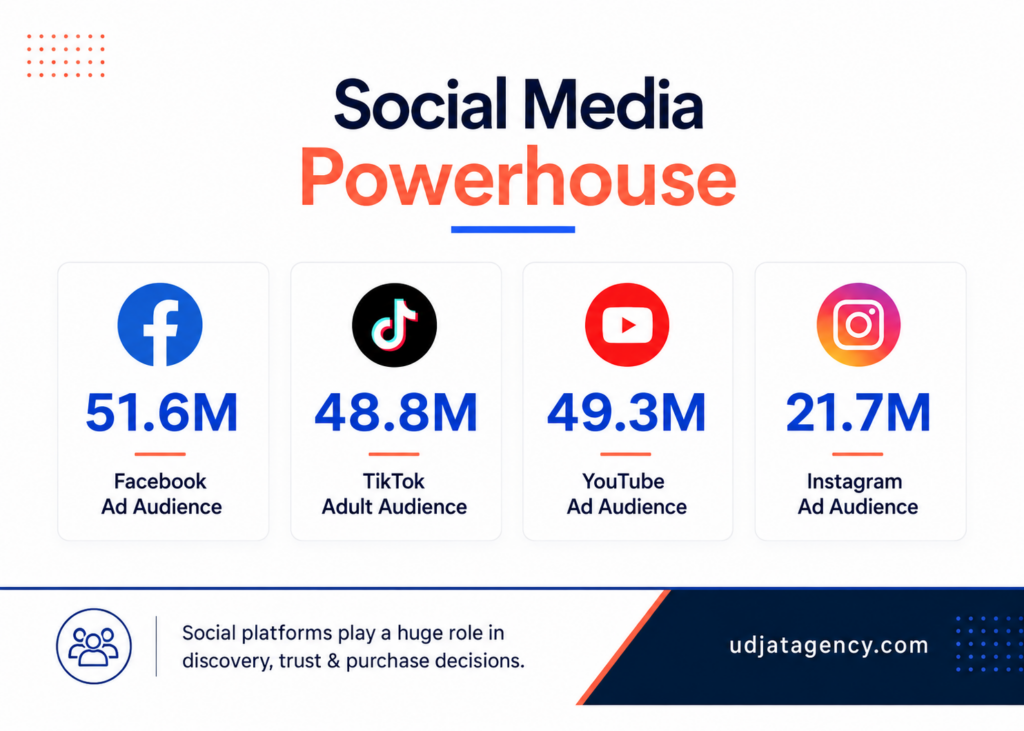
- 51.6 Million Social Media User Identities in Egypt
- Facebook eCommerce Marketing Statistics in Egypt
- TikTok eCommerce Marketing Statistics in Egypt
- Instagram eCommerce Statistics in Egypt
- YouTube eCommerce Statistics in Egypt
- Social Discovery Is Changing the Egyptian eCommerce Funnel
- SEO Is Becoming More Important for Egyptian eCommerce
- Egypt’s Financial Inclusion Reached 77.6%
- Egypt Had 43.7 Million Mobile Wallets
- Cash Still Matters in Egyptian eCommerce
- Egyptian eCommerce Cart Abandonment Is Around 81%
- CRO May Produce Better Returns Than More Advertising
- Retention Is Becoming More Important
- ERP Integration Becomes Important as eCommerce Scales
- Mobile Apps Can Become Valuable for High-Frequency eCommerce
- Fashion eCommerce in Egypt
- Food eCommerce Is Growing Rapidly
- Healthcare eCommerce Is Expanding
- Personal Care eCommerce
- Furniture eCommerce
- What the Statistics Mean for eCommerce Marketing in Egypt
- The Udjat eCommerce Growth Framework
- Frequently Asked Questions About eCommerce Marketing in Egypt Statistics
- How Big Is eCommerce in Egypt in 2026?
- How Many Internet Users Are There in Egypt?
- What Percentage of Egyptians Shop Online?
- Is Egypt a Mobile-First eCommerce Market?
- How Many Facebook Users Can Advertisers Reach in Egypt?
- How Many TikTok Users Can Advertisers Reach?
- How Many Instagram Users Can Advertisers Reach?
- What Is the Cart-Abandonment Rate in Egypt?
- How Many Mobile Wallets Are There in Egypt?
- Is Digital Payment Growing?
- Is Shopify Good for Egypt?
- Should Egyptian eCommerce Businesses Invest in SEO?
- Do Online Stores Need Email Marketing?
- Final Takeaway: Egypt’s Biggest eCommerce Opportunity Is Conversion
- References
eCommerce Marketing in Egypt Statistics: 2026 Market Data, Consumer Trends & Growth Opportunities
The latest eCommerce marketing in Egypt statistics reveal a market with an unusual combination of enormous digital reach and relatively low online-shopping penetration.
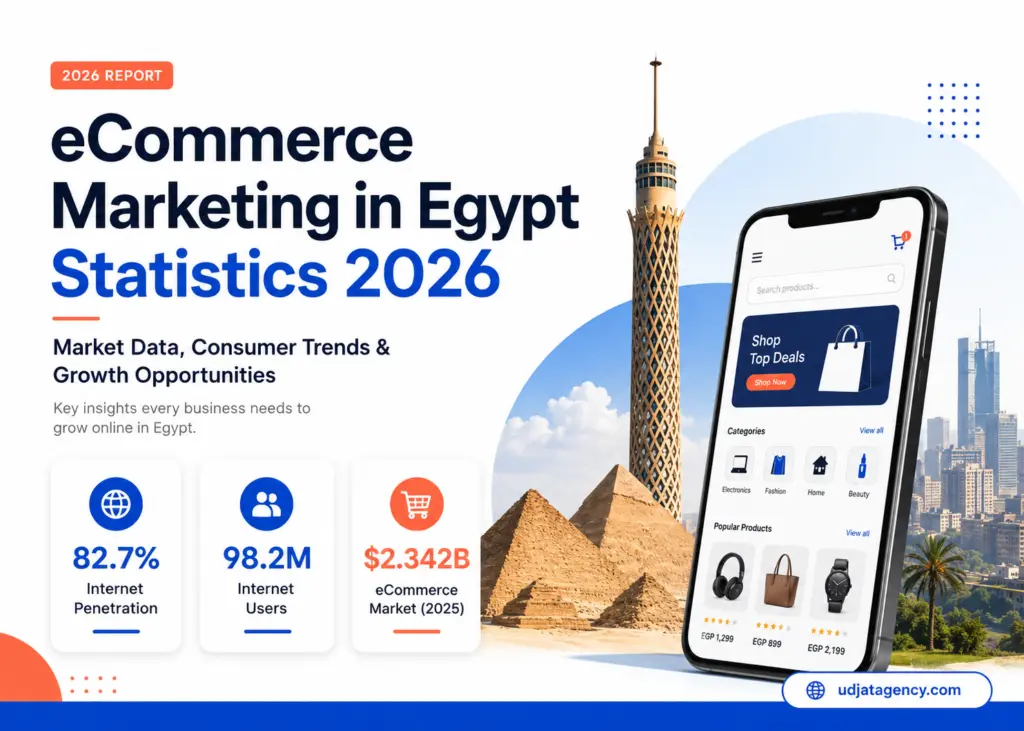
Egypt had approximately 98.2 million internet users by late 2025, representing 82.7% of the population.
At the same time, the U.S. International Trade Administration reports that only around 8.3% of Egyptians make regular online purchases.
That gap may be the most important eCommerce statistic in Egypt.
Egypt does not primarily have an internet-access problem anymore.
It has an eCommerce conversion and adoption opportunity.
Millions of Egyptians are already:
- Online
- Using social media
- Watching videos
- Using mobile phones
- Using digital wallets
- Transferring money electronically
But a much smaller proportion regularly purchases products online.
This is exactly why a successful eCommerce marketing strategy in Egypt cannot depend only on acquiring more traffic.
Winning Egyptian eCommerce increasingly requires:
discovery → trust → product experience → mobile UX → payment flexibility → checkout → delivery → retention
For businesses planning to enter the market, Udjat’s broader guide to eCommerce in Egypt provides additional context around platforms, operations, payments and launch strategy.
This report gathers the most important current statistics available for understanding eCommerce marketing in Egypt in 2026 and translates those numbers into practical decisions for retailers, founders, CEOs, eCommerce managers and marketing teams.
eCommerce Marketing in Egypt Statistics: Quick Summary
| Statistic | Latest figure |
|---|---|
| Egypt population | ~119 million |
| Internet users | 98.2 million |
| Internet penetration | 82.7% |
| Cellular mobile connections | 121 million |
| Broadband-capable mobile connections | 95.4% |
| Social media user identities | 51.6 million |
| Social media users aged 18+ | 51.3 million |
| Facebook advertising audience | 51.6 million |
| TikTok adult advertising audience | 48.8 million |
| YouTube advertising audience | 49.3 million |
| Instagram advertising audience | 21.7 million |
| Regular online-purchase penetration | 8.3% |
| ECDB 2025 eCommerce revenue estimate | US$2.342 billion |
| ECDB 2025 eCommerce growth | 20–25% |
| ECDB 2026 growth forecast | 15–20% |
| ECDB cart abandonment benchmark | 80.5–81.0% |
| ECDB add-to-cart benchmark | 9.5–10.0% |
| Financial inclusion | 77.6% |
| Citizens with active transaction accounts | 54.7 million |
| Mobile wallets — Q1 2025 | 43.7 million |
| Mobile-wallet transactions — Q1 2025 | 589 million |
| Mobile-wallet transaction value — Q1 2025 | EGP 859.2 billion |
These numbers explain why Egyptian businesses increasingly need a combination of performance marketing, SEO, social commerce, CRO, retention and strong store technology rather than treating eCommerce as a single advertising channel.
How Big Is the eCommerce Market in Egypt?
Different research companies report different market-size estimates because they do not all define “eCommerce” in the same way.
ECDB: US$2.342 Billion in 2025
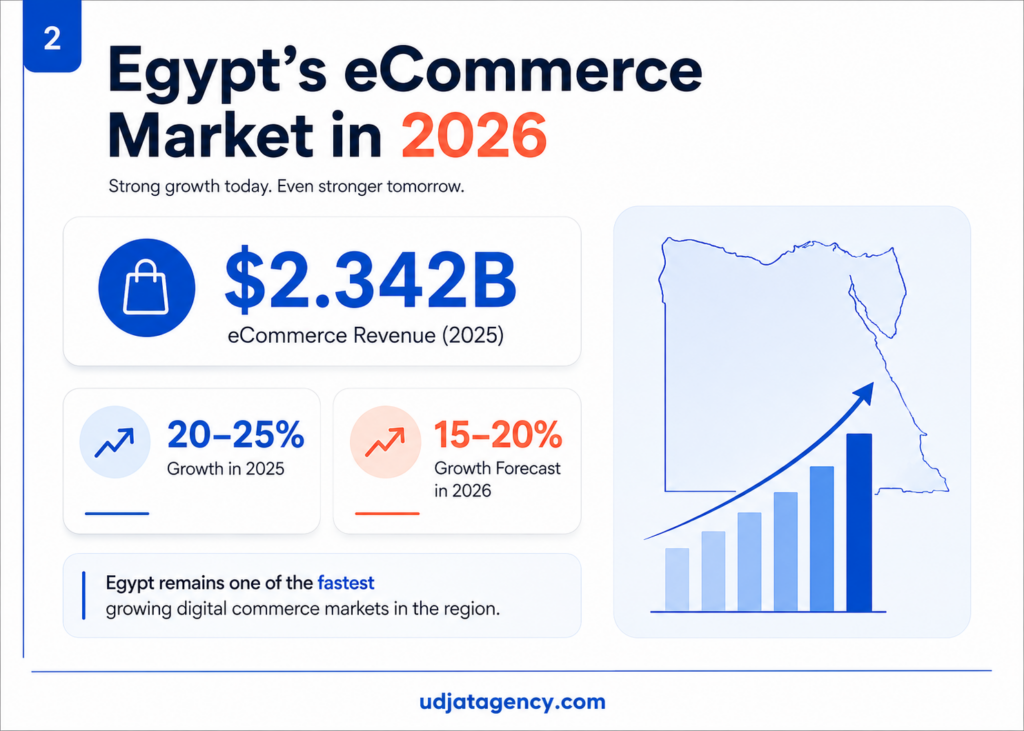
ECDB estimates that Egypt’s eCommerce market generated approximately US$2.342 billion in online retail revenue during 2025.
It estimates year-on-year growth of 20–25% in 2025 and forecasts another 15–20% change for 2026.
ECDB also reported approximately US$228 million in Egyptian eCommerce revenue during July 2026, up an estimated 10–15% from the previous month.
This indicates a rapidly expanding digital retail market.
For entrepreneurs considering entering the market, this growth should be evaluated alongside startup costs, platform choice and logistics. Udjat’s guide explaining how to start an eCommerce business in Egypt covers that process in more detail.
Mordor Intelligence: US$11.49 Billion in 2026
Mordor Intelligence estimates the broader Egypt eCommerce market at US$11.49 billion in 2026, with a forecast of US$20.15 billion by 2031 and an estimated CAGR of 11.89%.
The difference is largely methodological.
Mordor uses a broader measurement of gross merchandise value generated by B2C and B2B online transactions, including physical and digitally delivered services.
Which eCommerce Market Size Is Correct?
Both figures can be useful when the methodology is stated.
Do not say:
Egypt’s eCommerce market is exactly $X billion.
A more accurate description is:
Egypt’s eCommerce market is growing rapidly, while published estimates vary depending on whether research measures narrower retail revenue, broader GMV, B2C, B2B or digitally delivered services.
Brands evaluating entry into the market should therefore combine market statistics with market research rather than relying on a single headline figure.
Egypt’s eCommerce Market Grew 20–25% in 2025
ECDB estimates that Egyptian eCommerce revenue grew approximately 20–25% during 2025, with another 15–20% increase forecast for 2026.
That suggests Egypt remains a growth market rather than a mature eCommerce economy.
Expansion is being supported by:
- Increasing digital familiarity
- Better mobile connectivity
- More digital-payment options
- Marketplace adoption
- Social commerce
- Improving logistics
- More traditional retailers moving online
However, rapid market expansion also attracts competition.
The number of companies investing in:
- Meta Ads
- TikTok
- Google Ads
- marketplaces
- SEO
- influencer marketing
- Shopify
- WooCommerce
continues to increase.
This makes professional eCommerce growth strategy increasingly important.
The question is no longer:
Should our business sell online?
It is:
How can our online business acquire customers profitably?
Only 8.3% of Egyptians Regularly Shop Online
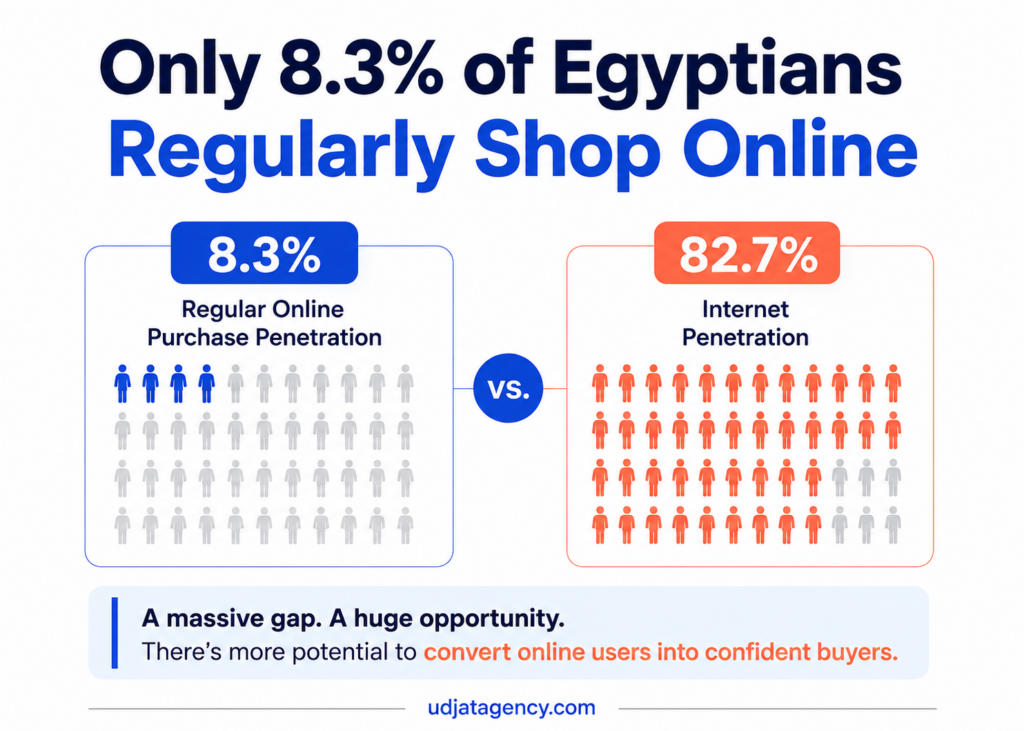
The U.S. International Trade Administration reports that approximately 8.3% of Egyptians make regular online purchases.
Compare that with:
82.7% internet penetration.
That creates a major gap between:
people who have internet access
and
people who regularly purchase online.
What Does This Mean for Egyptian eCommerce?
Businesses cannot assume every visitor behaves like an experienced eCommerce customer.
Many shoppers may need additional reassurance regarding:
- Product authenticity
- Delivery
- Returns
- Payment
- Security
- Seller credibility
- Customer service
This makes trust-building content especially important.
Useful content marketing can reduce uncertainty through:
- Product education
- Buying guides
- Comparisons
- FAQs
- Reviews
- tutorials
- case studies
Egyptian eCommerce brands therefore need to think beyond acquiring clicks.
They need to build purchase confidence.
Online Commerce Still Represents a Small Share of Egyptian Retail
ECDB places Egypt’s online share of retail revenues within the 0–5% range.
Regardless of the exact methodology, physical retail remains dominant.
That can actually be considered an opportunity.
Egypt already has:
- 98.2 million internet users
- 51.6 million social-media identities
- growing mobile-payment adoption
- extensive mobile connectivity
Yet much consumer spending still happens offline.
The growth opportunity is therefore partly:
offline purchasing → digital purchasing
Businesses looking to move traditional retail operations online should carefully evaluate which eCommerce platform is best for their business model before investing heavily in acquisition.
Egypt Has 98.2 Million Internet Users
DataReportal estimates that Egypt had approximately 98.2 million internet users in October 2025.
Internet penetration reached approximately 82.7%.
The internet population increased by approximately 2.3 million users between October 2024 and October 2025.
For retailers, digital audience availability is therefore enormous.
The more important challenge is becoming discoverable.
That makes SEO in Egypt strategically important for eCommerce companies trying to generate traffic without paying for every visit.
Egypt Is a Mobile-First eCommerce Market
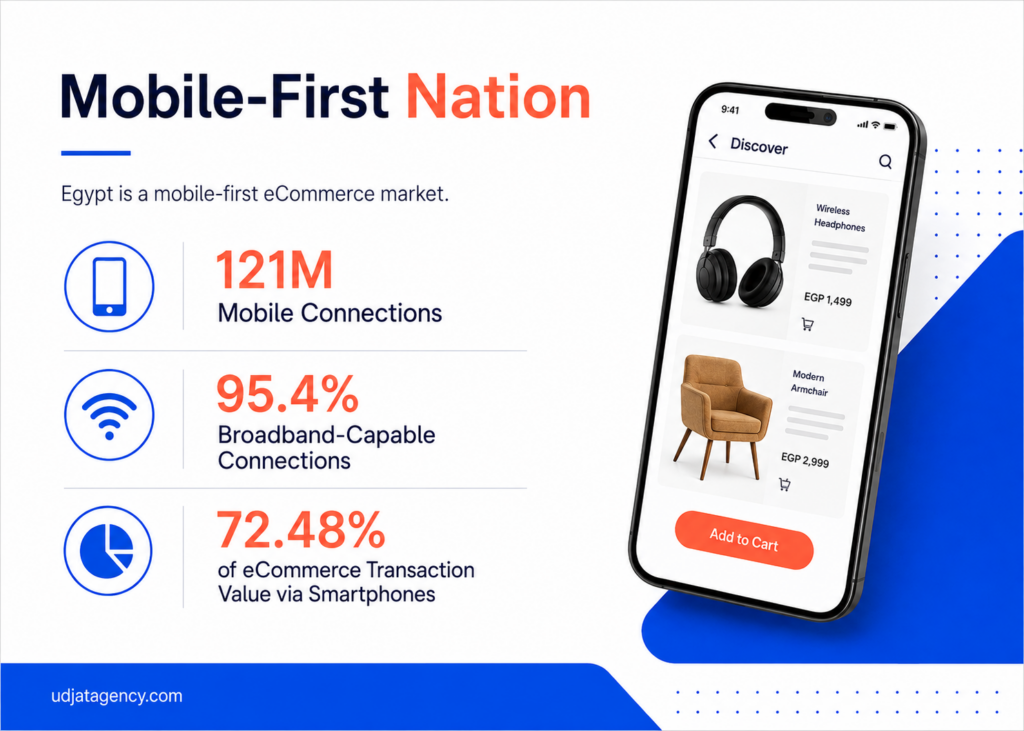
Egypt had approximately 121 million cellular mobile connections by late 2025.
Around 95.4% of those connections were capable of accessing 3G, 4G or 5G broadband networks.
Mordor Intelligence estimates that smartphones accounted for approximately 72.48% of Egyptian eCommerce transaction value in 2025.
That makes mobile optimization commercially critical.
Egyptian Online Stores Should Prioritize
- Fast loading
- Responsive design
- Clear mobile navigation
- Large buttons
- Short forms
- Strong product images
- Arabic and English usability
- Quick payment selection
- Easy checkout
- WhatsApp support
A store should not be designed for desktop first and then merely “made responsive.”
Mobile should influence the entire architecture.
Businesses planning a technically complex store should consider whether they need WordPress and WooCommerce development, Shopify, or a more custom solution.
Udjat’s software and web development services cover stores, custom platforms and integrations where standard eCommerce platforms are not enough.
Shopify Is Becoming an Important eCommerce Option
Many Egyptian brands choose Shopify because it reduces some of the technical burden associated with managing an online store.
However, launching Shopify does not automatically create sales.
Growth still requires:
- SEO
- advertising
- content
- conversion
- retention
Businesses already using Shopify can explore Udjat’s dedicated Shopify marketing services in Egypt for growth beyond the store setup itself.
Egypt Has a Young Digital Consumer Base
Egypt’s median age was approximately 24.5 years in late 2025.
DataReportal estimates:
- 11.9% of the population was 18–24
- 15.0% was 25–34
- 13.6% was 35–44
This creates an enormous audience familiar with:
- Short-form video
- Social discovery
- Mobile payments
- Creator content
- Digital-first brands
That is one reason social media is becoming central to Egyptian eCommerce discovery.
51.6 Million Social Media User Identities in Egypt
Egypt had approximately 51.6 million social-media user identities in October 2025.
Around 51.3 million adults could potentially be reached through social-media advertising tools.
For eCommerce businesses, social platforms serve several different functions:
- Product discovery
- Demonstration
- UGC
- Reviews
- Influencer marketing
- Retargeting
- Offers
- Customer service
This is why eCommerce companies should connect their store strategy with a structured social media management strategy.
Facebook eCommerce Marketing Statistics in Egypt
Meta’s advertising tools indicated a potential Facebook advertising audience of approximately 51.6 million people in Egypt.
Potential Facebook reach represented roughly:
- 43.4% of Egypt’s total population
- 52.5% of internet users
- 68.8% of adults
Facebook’s advertising audience also increased significantly over the preceding year.
For broad-market eCommerce, Facebook remains useful for:
- Catalog campaigns
- Retargeting
- Offers
- Community-building
- Mass-market products
But advertisers should avoid assuming Facebook alone creates the entire customer journey.
TikTok eCommerce Marketing Statistics in Egypt
TikTok’s advertising tools reported approximately 48.8 million users aged 18 and above in Egypt.
TikTok advertising potentially reached approximately:
- 65.5% of Egyptian adults
- 49.7% of Egypt’s internet population
The potential advertising audience increased by approximately 25.2% year-over-year.
For categories such as:
- Fashion
- Beauty
- Accessories
- Gadgets
- Food
- Home products
TikTok can be a powerful discovery engine.
Successful creative frequently looks less like an advertisement and more like:
- UGC
- demonstrations
- reviews
- tutorials
- before/after
- comparisons
- problem-solution content
This is where social-media advertising should integrate with performance marketing rather than being evaluated only by views or engagement.
Instagram eCommerce Statistics in Egypt
Instagram advertising tools reported an audience of approximately 21.7 million users in Egypt.
Potential advertising reach grew approximately 13.9% during the preceding year.
Instagram remains particularly relevant for:
- Fashion
- Furniture
- Restaurants
- Beauty
- Jewelry
- Fitness
- Premium products
The platform performs particularly well when product marketing combines:
visual storytelling + social proof + creator content + retargeting
YouTube eCommerce Statistics in Egypt
YouTube’s advertising audience reached approximately 49.3 million people in Egypt.
That was equivalent to around half of Egypt’s internet audience.
YouTube is particularly useful for high-consideration products.
Examples include:
- Electronics
- Furniture
- Appliances
- Fitness equipment
- Technology
- Expensive consumer goods
A TikTok video may create curiosity.
A detailed YouTube comparison may create confidence.
A Google search may capture the final purchase intent.
This is why eCommerce growth should be understood as a multi-channel customer journey.
Social Discovery Is Changing the Egyptian eCommerce Funnel
The traditional funnel was:
Google → product page → purchase
The modern Egyptian consumer may behave more like:
TikTok → Instagram → Google → review → website → Facebook retargeting → WhatsApp → checkout
This makes attribution more difficult.
The store should distinguish between:
Demand Creation
TikTok, influencers, social video.
Demand Capture
Google Ads, SEO, branded search.
Conversion
Product pages, offers, checkout.
Retention
Email, WhatsApp, loyalty.
Udjat’s wider digital marketing services are built around connecting these channels instead of treating each one as an isolated campaign.
SEO Is Becoming More Important for Egyptian eCommerce
Paid advertising can create immediate demand.
SEO creates an asset that can continue generating traffic.
Online stores should optimize:
- Product pages
- Category pages
- brand pages
- buying guides
- comparison pages
- technical structure
- internal linking
Udjat has a dedicated guide on increasing organic traffic for eCommerce stores in Egypt covering this opportunity in more detail.
For companies needing a deeper technical programme, explore Udjat’s SEO agency services.
Egypt’s Financial Inclusion Reached 77.6%
The Central Bank of Egypt reported that financial inclusion reached approximately 77.6% by the end of 2025.
Approximately 54.7 million Egyptians aged 15 and above had active transactional accounts.
These included:
- Bank accounts
- Egypt Post accounts
- Mobile wallets
- Prepaid cards
Financial inclusion increased dramatically between 2016 and 2025.
That creates a much larger potential digital-commerce audience.
Egypt Had 43.7 Million Mobile Wallets
NTRA reported approximately 43.7 million mobile wallets in Q1 2025.
Those wallets processed:
- 589 million transactions
- EGP 859.2 billion in transaction value
Compared with Q1 2024:
- Wallet numbers increased 31%
- Transaction volume increased 61%
- Transaction value increased 63%
This is strong evidence of rapidly changing payment behavior.
However, wallet-to-wallet transfers still represented a significant portion of wallet activity.
Therefore:
digital-wallet adoption does not automatically equal online-shopping adoption.
The infrastructure exists.
Merchants still need to convince customers to use it commercially.
Cash Still Matters in Egyptian eCommerce
The U.S. International Trade Administration continues to identify cash as an important payment method in Egypt.
It also highlights obstacles such as:
- Consumer trust
- Payment security
- Digital literacy
- Logistics
Egyptian stores should therefore consider offering several options:
- Cards
- Mobile wallets
- Instant payment
- Cash on delivery
- Installments
The right mix depends on:
- Product category
- Customer segment
- Average order value
- geography
Egyptian eCommerce Cart Abandonment Is Around 81%
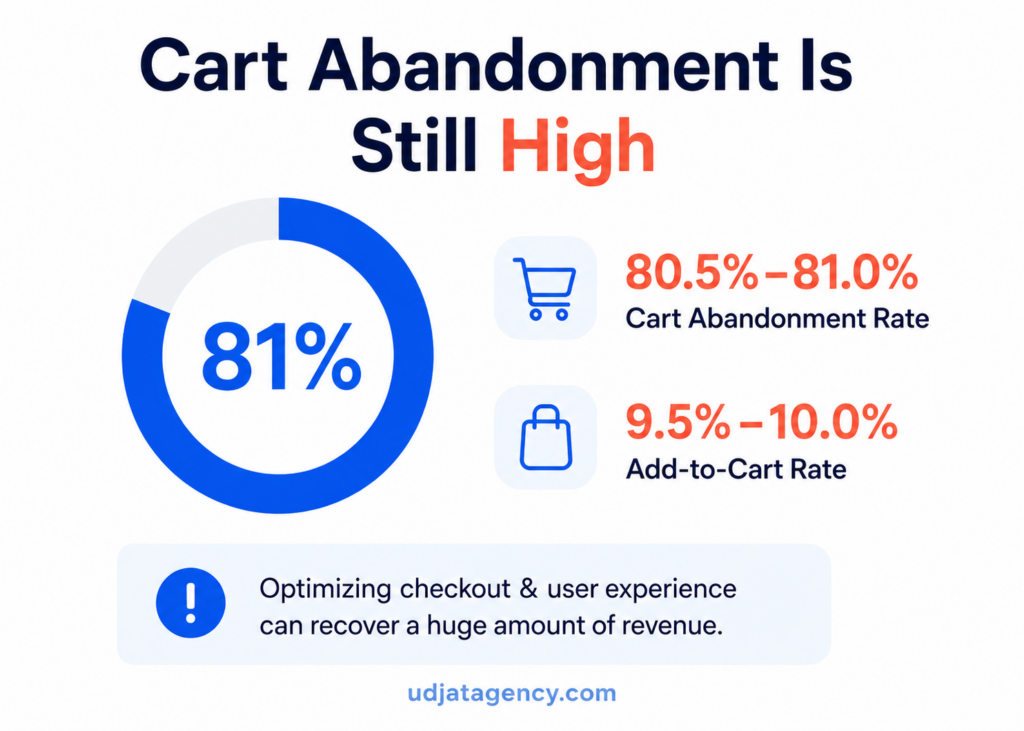
ECDB’s benchmark puts Egyptian eCommerce cart abandonment around 80.5–81.0%.
It estimates add-to-cart rates around 9.5–10.0%.
That means approximately four out of every five shopping carts may not become completed orders under this benchmark.
This should completely change the way businesses think about advertising.
Before increasing ad budgets, investigate:
- Unexpected shipping cost
- Slow checkout
- Forced registration
- Payment problems
- Product uncertainty
- Lack of trust
- Checkout bugs
- Poor mobile experience
Udjat’s eCommerce marketing services treat checkout and conversion as part of marketing performance—not merely a development issue.
CRO May Produce Better Returns Than More Advertising
Consider a store receiving 100,000 monthly visitors.
If the conversion rate improves from 1% to 1.5%, orders increase by 50% without increasing traffic.
This is why serious performance marketing for eCommerce needs to look beyond campaign dashboards.
Advertising creates opportunity.
Conversion determines how much value the business captures from that opportunity.
Retention Is Becoming More Important
Acquiring a customer through advertising can be expensive.
Once the first order is completed, the store should work to generate another purchase without paying the same acquisition cost again.
Retention channels include:
- Loyalty
- Bundles
- Cross-selling
- Product replenishment
- Personalization
Udjat’s dedicated email marketing agency in Egypt covers lifecycle campaigns such as:
- Welcome sequences
- Abandoned-cart recovery
- Post-purchase automation
- Win-back campaigns
For eCommerce brands, these flows should be treated as revenue infrastructure.
ERP Integration Becomes Important as eCommerce Scales
A store may begin with:
- Shopify
- WooCommerce
but eventually need integration with:
- ERP
- Accounting
- Inventory
- Warehouses
- CRM
- shipping providers
Poor integration creates problems such as:
- Wrong stock quantities
- Overselling
- Manual order processing
- Accounting errors
- Slow fulfillment
Udjat’s guide to integrating ERP with WooCommerce and Shopify explains how businesses can prepare for this stage.
This is also where a company combining marketing and software capabilities becomes especially valuable.
Mobile Apps Can Become Valuable for High-Frequency eCommerce
Not every store needs an app.
But businesses with:
- Frequent repeat purchases
- Loyalty programmes
- Push-notification strategies
- large customer bases
- complex ordering experiences
may eventually benefit from a dedicated mobile experience.
Udjat also provides mobile app development for businesses whose eCommerce strategy has moved beyond the website alone.
Fashion eCommerce in Egypt
ECDB estimates that Egyptian fashion eCommerce generated approximately US$401 million during 2025.
Estimated growth was around 15–20%.
Apparel accounted for roughly 59% of ECDB’s fashion category.
Fashion is particularly suited to:
- TikTok
- UGC
- influencers
- paid social
- retargeting
- email retention
However, competition also makes branding increasingly important.
The store cannot rely forever on:
Same product + lower price.
Food eCommerce Is Growing Rapidly
ECDB estimates Egypt’s online food segment generated approximately US$90 million during 2025.
Estimated annual growth reached around 30–35%.
This creates opportunities around:
- Online grocery
- restaurants
- delivery
- subscriptions
- quick commerce
Restaurants and food brands also benefit heavily from:
- local SEO
- Meta
- TikTok
- Google Maps
- retention marketing
Healthcare eCommerce Is Expanding
ECDB estimates Egypt’s healthcare eCommerce category generated approximately US$98 million during 2025, with estimated growth of around 25–30%.
This market requires additional attention to:
- Accuracy
- Trust
- Regulation
- privacy
- product information
Healthcare brands should never treat eCommerce marketing exactly like fashion marketing.
Personal Care eCommerce
ECDB estimates Egyptian personal-care eCommerce generated approximately US$100 million during 2025.
This category is well suited to:
- UGC
- creator marketing
- reviews
- demonstrations
- subscriptions
- bundles
- email retention
Strong content marketing strategy can be especially valuable when buyers need education before purchasing.
Furniture eCommerce
Egyptian furniture eCommerce generated approximately US$182 million during 2025, according to ECDB’s methodology.
Furniture buyers require more information than many fashion shoppers.
They may need:
- Dimensions
- photos
- videos
- delivery information
- reviews
- financing
- visualization
For these products, Google Search and SEO can become particularly important because purchase intent is often researched over a longer period.
What the Statistics Mean for eCommerce Marketing in Egypt
The statistics suggest eight major priorities.
1. Stop Treating Traffic as the Main KPI
Measure:
- Conversion rate
- CAC
- ROAS
- MER
- cart abandonment
- AOV
- repeat purchase rate
- lifetime value
Traffic is useful only when it contributes to business results.
2. Build Mobile-First
With smartphones estimated to represent more than 70% of Egyptian eCommerce transaction value, mobile experience should be tested first.
3. Use Social Media to Create Demand
TikTok, Instagram, Facebook and YouTube give Egyptian brands massive distribution.
4. Use Search to Capture Demand
Customers who discover products socially often eventually search Google.
This makes SEO and paid search essential.
5. Fix Checkout Before Scaling Media
An approximately 81% cart-abandonment benchmark represents a major revenue leak.
6. Offer Payment Flexibility
Egypt is moving quickly toward digital payments while cash remains important.
Support the customer’s preferred method.
7. Invest in Trust
High internet penetration does not automatically create eCommerce trust.
Use:
- reviews
- UGC
- transparent policies
- contact information
- clear delivery
- reliable support
8. Build Retention Early
Do not wait until acquisition costs become unsustainable before creating:
- loyalty
- cross-sell
- win-back campaigns
The Udjat eCommerce Growth Framework
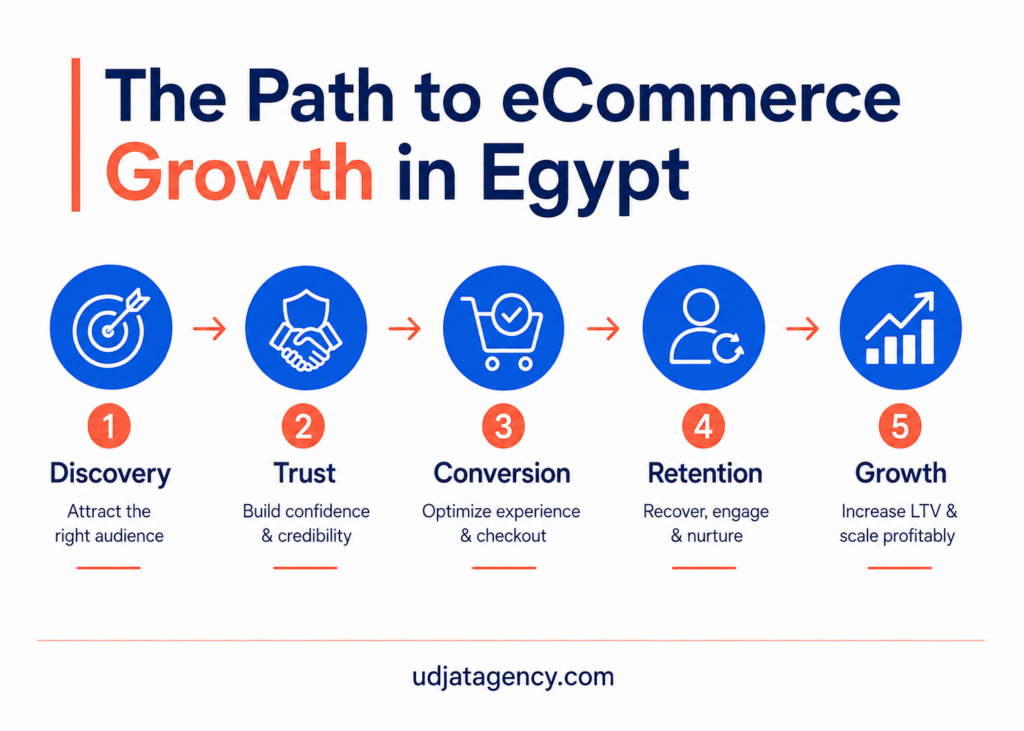
A practical Egyptian eCommerce funnel can be organized around five stages.
Stage 1 — Discovery
Use:
- TikTok
- creators
- SEO
Stage 2 — Trust
Use:
- Reviews
- UGC
- buying guides
- product education
- brand authority
Stage 3 — Conversion
Optimize:
- Mobile UX
- product pages
- checkout
- shipping
- payments
Stage 4 — Recovery
Use:
- Meta retargeting
- Google remarketing
- abandoned-cart email
Stage 5 — Retention
Use:
- loyalty
- personalization
- bundles
- subscriptions
This is why Udjat positions eCommerce marketing as a connected growth system rather than merely an advertising service.
Frequently Asked Questions About eCommerce Marketing in Egypt Statistics
How Big Is eCommerce in Egypt in 2026?
There is no single universally accepted figure.
ECDB reported approximately US$2.342 billion in narrower eCommerce revenue during 2025, while Mordor Intelligence estimates a broader US$11.49 billion Egyptian eCommerce market for 2026.
The difference primarily reflects methodology.
Businesses planning entry should read Udjat’s complete guide to eCommerce in Egypt rather than relying on one market-size number.
How Many Internet Users Are There in Egypt?
Approximately 98.2 million in late 2025.
What Percentage of Egyptians Shop Online?
Approximately 8.3% regularly purchase online, according to the U.S. International Trade Administration.
Is Egypt a Mobile-First eCommerce Market?
Yes.
Smartphones are estimated to generate approximately 72.48% of eCommerce transaction value.
How Many Facebook Users Can Advertisers Reach in Egypt?
Approximately 51.6 million according to Meta advertising planning data.
How Many TikTok Users Can Advertisers Reach?
Approximately 48.8 million adults.
How Many Instagram Users Can Advertisers Reach?
Approximately 21.7 million.
What Is the Cart-Abandonment Rate in Egypt?
ECDB’s benchmark puts cart abandonment at approximately 80.5–81.0%.
How Many Mobile Wallets Are There in Egypt?
NTRA reported approximately 43.7 million mobile wallets in Q1 2025.
Is Digital Payment Growing?
Yes.
Mobile-wallet transaction volume increased approximately 61% year-over-year in Q1 2025.
Is Shopify Good for Egypt?
It can be.
The correct answer depends on:
- Business size
- integrations
- catalog complexity
- customization
- payments
Read Udjat’s guide on choosing the best eCommerce platform before committing.
Should Egyptian eCommerce Businesses Invest in SEO?
Yes, particularly businesses that want to reduce dependence on paid acquisition.
Udjat’s SEO services and guide to organic eCommerce growth cover this area in greater detail.
Do Online Stores Need Email Marketing?
For most stores seeking repeat purchases, yes.
Lifecycle email can recover carts and increase customer lifetime value.
See Udjat’s email marketing services.
Final Takeaway: Egypt’s Biggest eCommerce Opportunity Is Conversion
The most important conclusion from these eCommerce marketing in Egypt statistics is not simply that Egypt has a large population.
It is the combination of several numbers:
98.2 million people are online.
51.6 million social-media identities exist.
48.8 million Egyptian adults can potentially be reached through TikTok advertising.
43.7 million mobile wallets were reported in Q1 2025.
54.7 million Egyptians have active transaction accounts.
Yet only approximately:
8.3% of Egyptians regularly purchase online.
That is the opportunity.
Egypt does not need another 100 million people to discover the internet before eCommerce can grow.
The audience already exists.
The challenge is moving more customers through:
discover → trust → add to cart → pay → receive → return → purchase again
The businesses that win will combine:
- eCommerce marketing
- performance marketing
- SEO
- content marketing
- social media management
- email marketing
- web and software development
- conversion optimization
- payment flexibility
- retention
- analytics
into one commercial system.
That is the difference between simply running an online store and building an eCommerce business.
References
- DataReportal — Digital 2026: Egypt
Internet population, mobile connectivity, social-media identities, Facebook, TikTok, Instagram and YouTube advertising reach. - Brightery — The Digital Report for Egypt (Internal)
- U.S. International Trade Administration — Egypt eCommerce Country Commercial Guide
Online-purchase penetration, cash usage, trust, logistics and eCommerce-adoption barriers. - ECDB — eCommerce Industry in Egypt
Retail eCommerce revenue, growth, online share, add-to-cart rates and cart abandonment. - Central Bank of Egypt — Financial Inclusion Strategy 2026–2030
Financial-inclusion rate and active transactional accounts. - National Telecommunications Regulatory Authority — Mobile Wallet Usage Indicators Q1 2025
Mobile-wallet numbers, transaction volume, value and annual growth. - Central Bank of Egypt — Contactless Payment Acceptance Through Smart Devices
Soft POS and digital-payment acceptance developments. - Mordor Intelligence — Egypt E-Commerce Market
Broader market-size estimates, forecasts and smartphone transaction share. - ECDB — Fashion eCommerce in Egypt
- ECDB — Food eCommerce in Egypt
- ECDB — Healthcare eCommerce in Egypt
- ECDB — Personal Care eCommerce in Egypt
- ECDB — Furniture eCommerce in Egypt
Methodology Note
Statistics in this report come from sources using different methodologies and reporting periods.
Advertising audience statistics should not be interpreted as monthly active-user counts.
Likewise, eCommerce market-size estimates should not be directly compared without checking whether a source measures retail revenue, GMV, B2C, B2B, services, cash-on-delivery orders or other categories.
Where credible sources use different definitions, this article keeps those differences visible rather than combining them into a misleading single number.