


Table of contents
- What actually drives app development cost in Egypt
- Real 2026 app development cost ranges: basic, medium, and complex
- App development rates in Egypt: what freelancers and agencies charge per hour
- Features that push your app development budget up fastest
- Timelines and post-launch costs most founders forget
- How to budget smartly and get an accurate quote
- Final numbers: app development cost in Egypt at a glance
App development cost in Egypt varies widely, ask three vendors to quote your project and you’ll get three completely different numbers. One quotes EGP 50,000, another says EGP 300,000, and the third sends a twelve-page proposal that still doesn’t name a price. That confusion isn’t unique to you; it’s the standard experience for founders who haven’t built software before. After working on mobile app projects across Cairo and the broader Egyptian market at Udjat Agency, the cost picture becomes far clearer once you understand what actually moves the price.
By the end of this guide, you’ll know realistic EGP and USD ranges for basic, medium, and complex apps, what freelancers and agencies charge per hour in 2026, which features eat your budget fastest, how long each project type takes to build, and what post-launch costs most founders quietly ignore until it’s too late. You’ll also leave with a clear framework for briefing vendors so the quotes you receive are actually comparable.
What actually drives app development cost in Egypt
Complexity and feature scope determine the floor
Complexity is the single biggest pricing variable in any mobile app project. A simple app with four to five screens and a straightforward user flow takes a fraction of the time of an app with live GPS tracking, payment processing, and a custom admin dashboard. The number of screens, the depth of the data layer, and the backend architecture all compound each other. An agency doesn’t just build screens, they build an entire system, and each feature you add creates dependencies that ripple through the rest of the project.
Platform choice: Flutter vs native development
Cross-platform frameworks like Flutter dramatically reduce cost compared to building separate native iOS and Android apps. In Egypt’s market in 2026, many small-to-medium projects default to Flutter because one codebase covers both platforms, cutting development and testing time significantly. Flutter typically saves 30 to 40% compared to building two separate native apps. Native development remains the right call for performance-critical or hardware-heavy applications, but it adds meaningful time and cost to any project. React Native sits in the same cross-platform tier and is a reasonable alternative for teams with existing JavaScript expertise.
Team type: freelancer, agency, or in-house
Each hiring model carries a different risk-to-cost profile. A freelancer charges less per hour but introduces real coordination risk: if they disappear mid-project or hit a technical wall outside their skill set, your timeline and budget both take the hit. An agency brings a full team, project management, and accountability under one contract, more expensive upfront, but a more predictable outcome. In-house development is rarely practical for Egyptian businesses that need a single product built; the monthly payroll for even a small mobile team in Cairo is significant before the first line of production code ships.
Real 2026 app development cost ranges: basic, medium, and complex
Basic app: what you get and what it costs
A basic app means four to seven screens, a single user role, simple CRUD functionality, basic authentication, and no payments or live data. This is the MVP tier, designed to validate an idea before serious investment. The cost to build an app in Egypt at this tier typically runs EGP 150,000 to 400,000, roughly $3,000 to $8,000 USD at current exchange rates when working with an established agency. Freelancer-built MVPs can come in well below that range, but the lower price almost always reflects scope cuts that create technical debt and require expensive fixes before the product can scale.
Medium app: the most common project tier
Medium-complexity apps include multiple user roles, payment integration, push notifications, an admin panel, and third-party API connections. This is where the majority of commercial app projects in Egypt land. Budget EGP 250,000 to 700,000, or $4,500 to $20,000 USD, for this tier. Timeline factors heavily into this cost; a three-to-five month agency engagement with proper UI/UX, QA, and backend work produces a fundamentally different product than a six-week freelance sprint aimed at the same feature list.
Complex app: what pushes costs past EGP 500,000
Complex apps are better understood as platforms: live delivery tracking, marketplace architecture, AI-powered features, a heavy backend, enterprise integrations, or strict security and compliance requirements. These projects start at EGP 500,000 and can reach EGP 2,000,000 or more, equivalent to $20,000 to $100,000+ USD. They run a minimum of five to eight months, and enterprise-grade platforms routinely extend to nine to twelve months. This tier is not appropriate for founders who are still testing whether the idea works, start with an MVP, validate it, then expand.
App development rates in Egypt: what freelancers and agencies charge per hour
Freelance developer rates in 2026
Senior freelance developers in Egypt charge roughly $22 to $48 per hour on international platforms, with local EGP rates ranging from EGP 150 to EGP 800 per hour depending on seniority and stack. That range reflects a real difference in output quality. A junior developer taking on their first solo client project is not the same product as a specialized mobile engineer with a verified portfolio of shipped apps. Hiring at the bottom of that range often means significant rework before you can launch.
Agency blended team rates
App development agencies in Egypt typically operate at a blended rate of $20 to $35 per hour, covering the project manager, UI/UX designer, developers, and QA as a coordinated team. Specialized mobile agencies with senior talent can charge $35 to $70 per hour. When you pay an agency rate, you’re paying for coordination, accountability, and the full-team redundancy that keeps projects on track, not just lines of code. For most Egyptian business owners who need a working product with predictable delivery, the agency model is the more reliable path.
Features that push your app development budget up fastest
Low-cost and mid-range features to plan for
These are the features most commercial apps need, and they carry real cost implications worth planning for upfront. Push notifications add $500 to $5,000 depending on the complexity of segmentation logic. Basic user authentication runs $500 to $15,000 depending on the number of roles and security depth required. GPS and mapping features cost $1,500 to $15,000 based on whether you need a simple location pin or full live tracking. Admin dashboards fall in the $1,500 to $15,000 range depending on analytics and workflow complexity. Far from optional extras, these features form the operational backbone of most commercial apps.
High-cost features that reshape your architecture
A few features restructure the entire architecture, not just the invoice. Payment integration, including gateway setup with providers like Paymob or Fawry (Stripe is not available in Egypt), runs $1,500 to $25,000 when you factor in subscriptions, multi-currency support, and refund logic. Offline support adds $3,000 to $12,000 because of the backend sync complexity it creates. AI features range from $3,000 to $60,000 or more, depending on whether you’re adding a basic chatbot or building a custom recommendation engine. Requesting AI without scoping it properly is one of the most common reasons Egyptian app projects go significantly over budget.
Timelines and post-launch costs most founders forget
How long each app tier actually takes to build
Basic apps take two to three months and roughly 200 to 600 developer hours. Medium apps take three to five months and 600 to 1,500 hours. Complex apps take five to eight months and 1,500 to 4,000 or more hours, with enterprise-grade platforms extending to nine to twelve months depending on integrations and compliance requirements. Compressing any of these timelines puts pressure on testing and QA, and bugs caught after launch cost significantly more to fix than bugs caught during development. A compressed timeline is rarely a cost-saving move.
The 15, 20% annual rule for maintenance and support
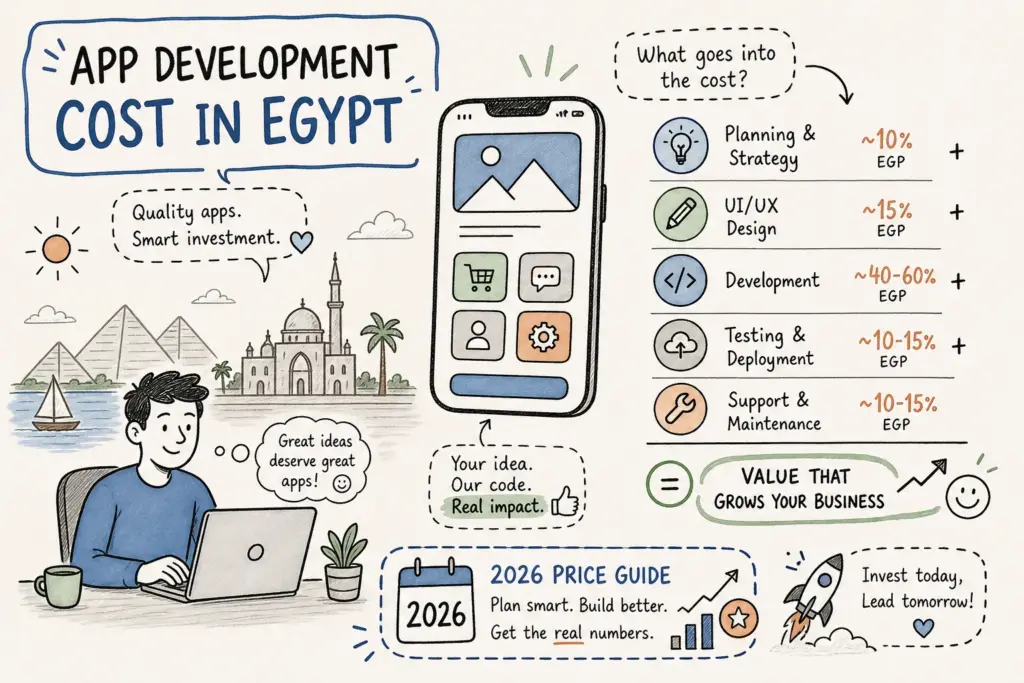
Most first-time app owners plan for the build and forget to budget for what comes after. Plan to spend 15 to 20% of your original build cost every year on maintenance, OS updates, app store compliance, security patches, and incremental improvements. Add hosting and infrastructure on top of that, typically $100 to $400 per month depending on backend complexity and user load. For an EGP 500,000 app, that’s roughly EGP 75,000 to EGP 100,000 per year just to keep it running well and current. Choosing an agency that offers a post-launch support contract is a practical way to protect that investment without scrambling for a new vendor every time something breaks. Note also that publishing on the Apple App Store costs $99 per year, while Google Play requires a one-time $25 registration fee.
How to budget smartly and get an accurate quote
What to prepare before you contact any vendor
A clear RFP, or Request for Proposal, should include a one-page app description, a prioritized list of core features, your target platform (iOS, Android, or both), expected user volume, any must-have integrations, and your timeline. Vendors who receive a vague brief return vague quotes. The more specific your inputs, the more comparable and honest the outputs will be. Breaking the project into phases, starting with an MVP and adding complexity in subsequent sprints, is almost always smarter than trying to build everything at once, both for cost control and for reducing technical risk.
Why working with a local Egyptian agency changes the equation
Udjat Agency combines competitive local rates, in-person Cairo meetings, and end-to-end delivery, covering design, development, QA, and post-launch support, all under one contract. For Egyptian founders who want quality work without paying Western agency rates or managing a fragmented team of freelancers across multiple contracts, that structure removes a significant amount of operational risk. The free consultation model means you can get a realistic scoped estimate before committing to anything, giving you an honest number to compare against other vendors rather than a vague ballpark.
Final numbers: app development cost in Egypt at a glance
Here’s a quick recap of what to expect across each tier:
- Basic app: EGP 150,000, 400,000 (~$3,000, $8,000 USD) | 2, 3 months
- Medium app: EGP 250,000, 700,000 (~$4,500, $20,000 USD) | 3, 5 months
- Complex platform: EGP 500,000, 2,000,000+ (~$20,000, $100,000+ USD) | 5, 12 months
- Agency blended rates: $20, $35/hr | Senior freelancers: $22, $48/hr
- Annual maintenance: 15, 20% of your original build cost
Flutter is a common default for small-to-medium business apps in Egypt unless your project has specific native hardware requirements, such as Bluetooth peripherals, custom camera pipelines, or specialized sensor integration, that demand platform-level access.
The biggest mistake Egyptian founders make isn’t picking the wrong platform or even choosing the wrong vendor. It’s skipping the planning phase and underestimating what it costs to keep the app alive after launch. Build a clear brief, budget 15 to 20% of your initial development cost annually for maintenance, and choose a vendor you can physically meet with and hold accountable to delivery milestones. That combination protects your investment more reliably than price-shopping alone.
If you want a precise estimate of app development cost in Egypt for your specific project, Udjat Agency offers a free consultation to walk through your requirements and give you an honest, scoped number before you make any commitment.