


Table of contents
- Ansoff Matrix: Market Penetration, Market Development, Product Development & Diversification Explained
- What Is the Ansoff Matrix?
- What Are the Four Strategies in the Ansoff Matrix?
- Why Businesses Use the Ansoff Matrix
- The Ansoff Matrix Is a Growth Direction Framework
- 1. Market Penetration
- Market Penetration Example
- How Can a Company Increase Market Penetration?
- Market Penetration Through Customer Acquisition
- Market Penetration Through Conversion
- Market Penetration Through Customer Retention
- Market Penetration Through Competitor Switching
- Market Penetration Example: Restaurant
- Market Penetration Example: Marketing Agency
- Market Penetration Advantages
- Market Penetration Risks
- When Should You Consider Market Penetration?
- 2. Market Development
- Market Development Example: Egypt to Saudi Arabia
- Geographic Market Development
- Segment-Based Market Development
- Market Development Example: B2B
- Market Development Example: FMCG
- Market Development and Localization
- Market Development Research Questions
- Market Development Advantages
- Market Development Risks
- When Should You Consider Market Development?
- 3. Product Development
- Product Development Example
- Product Development Can Mean More Than a Completely New Product
- Product Development Example: Agency
- Product Development Example: SaaS
- Product Development Example: Restaurant
- Product Development Example: Healthcare
- Why Product Development Can Be Attractive
- Product Development Research
- Product Development and Cannibalization
- Product Development Risks
- When Should You Consider Product Development?
- 4. Diversification
- Diversification Example
- Related Diversification
- Unrelated Diversification
- Diversification Example: Technology
- Diversification Example: FMCG
- Why Companies Diversify
- Diversification Questions
- Diversification Through Acquisition
- Diversification Risks
- Ansoff Matrix Risk: Which Strategy Is Riskiest?
- Ansoff Matrix Risk Table
- How to Choose Between Market Development and Product Development
- Ansoff Matrix Example: Egyptian SaaS Company
- Ansoff Matrix Example: Udjat-Style Marketing Agency
- Ansoff Matrix Example: eCommerce Brand
- Ansoff Matrix Example: Restaurant
- Ansoff Matrix Example: Real Estate Developer
- Ansoff Matrix Example: Hotel
- Ansoff Matrix Example: Professional Services
- The Ansoff Matrix for Small Businesses
- The Ansoff Matrix for Startups
- Ansoff Matrix for B2B Companies
- What Counts as a “New Market” in the Ansoff Matrix?
- What Counts as a “New Product”?
- The Ansoff Matrix and Market Research
- Ansoff Matrix and STP Marketing
- Ansoff Matrix and the 4Ps
- Ansoff Matrix and the 7Ps
- Ansoff Matrix and SOSTAC
- Ansoff Matrix and Go-to-Market Strategy
- Ansoff Matrix and Product Marketing
- Ansoff Matrix and Marketing Strategy
- Ansoff Matrix vs SWOT
- Ansoff Matrix vs PESTEL
- Ansoff Matrix vs BCG Matrix
- Ansoff Matrix vs Porter’s Generic Strategies
- Ansoff Matrix vs Blue Ocean Strategy
- How to Use the Ansoff Matrix Step by Step
- Step 1: Define the Current Product
- Step 2: Define the Current Market
- Step 3: Establish the Growth Objective
- Step 4: Assess Market Penetration
- Step 5: Assess Market Development
- Step 6: Assess Product Development
- Step 7: Assess Diversification
- Step 8: Estimate Opportunity
- Step 9: Estimate Risk
- Step 10: Assess Capability
- Step 11: Prioritize
- Step 12: Validate
- Ansoff Growth Opportunity Scorecard
- Ansoff Matrix Template
- Ansoff Evaluation Template
- Ansoff Matrix Decision Checklist
- Common Ansoff Matrix Mistakes
- Mistake 1: Thinking the Matrix Makes the Decision
- Mistake 2: Assuming Market Penetration Is Risk-Free
- Mistake 3: Entering New Countries Without Research
- Mistake 4: Building New Products Because Management Likes the Idea
- Mistake 5: Diversifying Because the Core Business Is Difficult
- Mistake 6: Ignoring Organizational Capability
- Mistake 7: Treating Every New Feature as Product Development
- Mistake 8: Treating Every Audience as a New Market
- Mistake 9: Ignoring Cannibalization
- Mistake 10: Scaling Before Testing
- The Ansoff Matrix and Growth Experiments
- How Udjat Can Apply the Ansoff Matrix
- Ansoff Matrix Quick Facts
- Frequently Asked Questions About the Ansoff Matrix
- What is the Ansoff Matrix?
- Who created the Ansoff Matrix?
- What are the four strategies of the Ansoff Matrix?
- What is another name for the Ansoff Matrix?
- What is Market Penetration in the Ansoff Matrix?
- What is an example of Market Penetration?
- How can businesses increase Market Penetration?
- What is Market Development?
- What is an example of Market Development?
- Does Market Development always mean entering another country?
- What is Product Development?
- What is a Product Development example?
- Is adding a feature Product Development?
- What is Diversification?
- What is a Diversification example?
- What is related diversification?
- What is unrelated diversification?
- Which Ansoff strategy is the least risky?
- Which Ansoff strategy is the riskiest?
- Why is Diversification risky?
- Can Diversification reduce business risk?
- What is the difference between Market Development and Product Development?
- What is the difference between Market Penetration and Market Development?
- How do you use the Ansoff Matrix?
- Is the Ansoff Matrix a marketing framework?
- Is the Ansoff Matrix still relevant?
- What are the limitations of the Ansoff Matrix?
- Does the Ansoff Matrix tell you which strategy to choose?
- How does the Ansoff Matrix connect with SWOT?
- How does Ansoff connect with PESTEL?
- How does Ansoff connect with STP?
- How does Ansoff connect with the 4Ps?
- How does Ansoff connect with the 7Ps?
- How does Ansoff connect with SOSTAC?
- How does Ansoff connect with Go-to-Market Strategy?
- How does Ansoff help with international expansion?
- How does Ansoff apply to digital businesses?
- Can small businesses use the Ansoff Matrix?
- Can startups use the Ansoff Matrix?
- Can Udjat conduct an Ansoff Matrix analysis?
- How can I start an Ansoff growth strategy project with Udjat?
- Conclusion: “We Want to Grow” Is Not a Strategy
- Sources
Ansoff Matrix: Market Penetration, Market Development, Product Development & Diversification Explained
A company wants:
20% growth next year.
Management agrees on the target.
Then comes the harder question:
Where exactly should that growth come from?
Should the company:
sell more of what it already sells to its current market?
Or:
take the existing product into a new market?
Or:
develop something new for current customers?
Or:
enter an entirely new market with an entirely new product?
These are fundamentally different growth strategies.
They require different:
- Research.
- Investment.
- Marketing.
- Product capabilities.
- Sales teams.
- Distribution.
- Risk tolerance.
The Ansoff Matrix helps leadership organize those decisions.
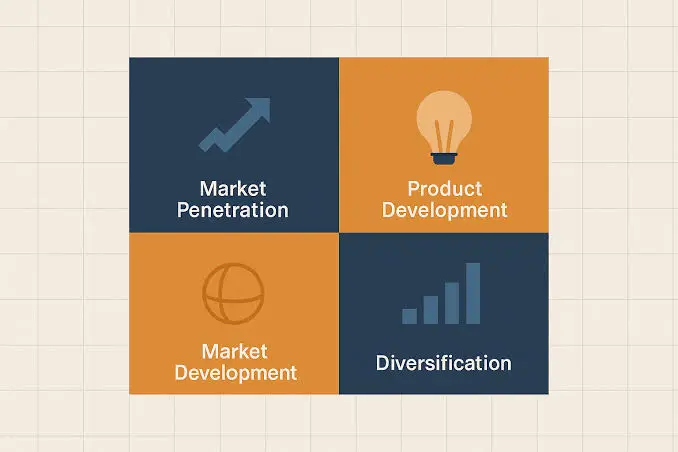
The framework presents four fundamental growth directions:
| Existing Products | New Products | |
|---|---|---|
| Existing Markets | Market Penetration | Product Development |
| New Markets | Market Development | Diversification |
In simple terms:
Market Penetration
Existing product + existing market
Sell more of what you already have to customers or markets you already understand.
Market Development
Existing product + new market
Take what already works into a new geography, segment or customer group.
Product Development
New product + existing market
Create additional products or services for customers you already know.
Diversification
New product + new market
Enter unfamiliar territory on both sides.
The strategic question behind the entire Ansoff Matrix is therefore:
Should growth come from the market, the product, or both?
At Udjat Agency, we would not use the Ansoff Matrix to mechanically select a quadrant.
We would use it to structure a more important discussion:
Where is the most attractive growth opportunity?
↓
What evidence supports it?
↓
What capabilities are required?
↓
What could go wrong?
↓
How should we test it?
↓
How do we take it to market?
The matrix gives leadership four directions.
Research determines which direction deserves investment.
What Is the Ansoff Matrix?
The Ansoff Matrix is a strategic planning framework businesses use to evaluate growth opportunities according to two dimensions:
Products
and:
Markets.
Each can be:
- Existing.
- New.
Combining those dimensions creates four strategies:
- Market Penetration.
- Market Development.
- Product Development.
- Diversification.
The framework is also commonly called the:
Product-Market Expansion Grid
or:
Product-Market Growth Matrix.
It is associated with strategist H. Igor Ansoff, whose work on product-market growth strategy dates to 1957.
Its enduring value comes from its simplicity.
Instead of asking vaguely:
How can we grow?
leadership can ask:
Are we trying to grow through existing or new products?
and:
Are we trying to grow within existing or new markets?
That immediately creates more strategic clarity.
What Are the Four Strategies in the Ansoff Matrix?
The four strategies are:
| Strategy | Product | Market | Basic Objective |
|---|---|---|---|
| Market Penetration | Existing | Existing | Sell more in the current market |
| Market Development | Existing | New | Take the existing offer into new markets |
| Product Development | New | Existing | Sell new offers to existing markets |
| Diversification | New | New | Enter new markets with new offers |
OpenStax similarly describes these four growth directions as market penetration, market development, product development and diversification.
The differences look simple.
The strategic consequences are significant.
Why Businesses Use the Ansoff Matrix
Growth discussions often begin with:
We need more sales.
But “more sales” can come from very different sources.
For example, an Egyptian SaaS company could grow by:
Market Penetration
Win more Egyptian businesses for its existing SaaS platform.
Market Development
Take that same SaaS platform into Saudi Arabia.
Product Development
Launch a new AI module for existing Egyptian customers.
Diversification
Build a new fintech product for GCC consumers.
Those four options require very different:
- Capital.
- Skills.
- Teams.
- Research.
- Technology.
- Marketing.
- Timeframes.
The Ansoff Matrix makes those differences visible.
The Ansoff Matrix Is a Growth Direction Framework
This is important.
The framework tells you:
Which broad direction could growth take?
It does not tell you:
- Which Google Ads campaign to run.
- Which audience to select on Meta.
- What your positioning should be.
- What price customers will accept.
- Which features to build.
- Which country to enter first.
Those require other frameworks and evidence.
That is why Udjat’s broader Marketing Frameworks approach treats the Ansoff Matrix as a growth-direction tool, not an entire business strategy.
1. Market Penetration
Market Penetration = Existing Products + Existing Markets
This is normally the most familiar Ansoff growth strategy.
The company already understands:
- Its product.
- Its customers.
- Its market.
- Its competitors.
The objective is:
Sell more of the current product within the current market.
OpenStax defines market penetration as focusing on increasing market share in an existing market.
Market Penetration Example
Imagine an Egyptian CRM company.
It already sells:
CRM software.
Its current market is:
Egyptian SMEs.
Market Penetration means:
Sell more CRM subscriptions to Egyptian SMEs.
The company is not changing:
- Product category.
- Geography.
- Core customer.
It is trying to win more of the existing opportunity.
How Can a Company Increase Market Penetration?
Possible approaches include:
- Increase awareness.
- Improve advertising.
- Improve sales.
- Improve distribution.
- Increase conversion.
- Gain competitor customers.
- Improve retention.
- Increase purchase frequency.
- Increase customer usage.
- Improve pricing or packaging.
- Expand channel coverage.
Market penetration does not simply mean:
Spend more on ads.
There are many ways to capture more value from an existing market.
Market Penetration Through Customer Acquisition
The most obvious route is:
Acquire more customers.
Possible channels include:
- SEO.
- Google Ads.
- Social media.
- LinkedIn.
- Digital PR.
- Events.
- Partnerships.
- Sales outreach.
The right mix depends on customer behaviour.
Market Penetration Through Conversion
Suppose a business already generates:
10,000 visitors
and:
200 enquiries.
Instead of doubling advertising, perhaps it can improve conversion.
At:
2% conversion
it gets:
200 enquiries.
At:
3% conversion
it gets:
300 enquiries.
Same traffic.
50% more enquiries.
That is still growth within the existing market.
Udjat’s Conversion Rate Optimization work can therefore contribute directly to a Market Penetration strategy.
Market Penetration Through Customer Retention
Businesses often think penetration means only:
New customers.
But existing customers may buy:
- More frequently.
- Larger quantities.
- Additional packages.
For subscription businesses:
reducing churn can materially increase revenue without entering a new market.
Market Penetration Through Competitor Switching
Another route is:
Win customers from competitors.
This requires understanding:
- Why customers are dissatisfied.
- What competitors do well.
- What switching costs exist.
- Which differentiator matters.
A strong competitive strategy might focus on:
- Better service.
- Better product.
- Lower total cost.
- Faster delivery.
- Specialization.
- Better experience.
Do not assume price is the only reason customers switch.
Market Penetration Example: Restaurant
Existing product:
Restaurant experience.
Existing market:
New Cairo customers.
Possible penetration strategies:
- Increase Google Maps visibility.
- Improve review volume.
- Introduce loyalty.
- Increase repeat visits.
- Improve weekday demand.
- Partner with nearby offices.
The restaurant does not need another city or another restaurant concept.
It wants a bigger share of its current opportunity.
Market Penetration Example: Marketing Agency
An agency already serves Egyptian businesses.
It could penetrate further through:
- Stronger SEO.
- Industry specialization.
- More case studies.
- Better sales conversion.
- Referral programmes.
- More effective lead generation.
It is selling current capabilities into its established market.
Market Penetration Advantages
Advantages include:
Existing Market Knowledge
The company already understands customers.
Existing Product
No complete new-product development process.
Existing Reputation
Brand awareness may already exist.
Existing Sales Capability
The sales team understands the offer.
Existing Customer Data
Decisions can rely on real evidence.
This often makes Market Penetration relatively less uncertain than the other three strategies.
Market Penetration Risks
Lower relative uncertainty does not mean no risk.
Potential problems include:
- Market saturation.
- Aggressive competitors.
- Discount wars.
- Rising CAC.
- Limited market size.
- Brand damage from overpromotion.
- Diminishing channel returns.
Eventually a company may reach the point where penetrating the existing market further becomes increasingly expensive.
Then another Ansoff direction may become attractive.
When Should You Consider Market Penetration?
Consider it when:
- The market is still attractive.
- Customer demand exists.
- Product-market fit is strong.
- Market share is relatively low.
- Acquisition economics work.
- Competitors have vulnerable customers.
- Conversion can improve.
- Distribution has gaps.
A business should not abandon a healthy market simply because:
entering a new country sounds more exciting.
Sometimes the best growth opportunity is still at home.
2. Market Development
Market Development = Existing Products + New Markets
The company keeps the core product but introduces it to a new market.
A new market might mean:
- New country.
- New city.
- New customer segment.
- New demographic.
- New industry.
- New distribution environment.
AQA’s guidance on the Ansoff Matrix describes Market Development as taking existing products toward new customer segments, which may involve a new geography or a different demographic, income or behavioural group.
Market Development Example: Egypt to Saudi Arabia
Imagine an Egyptian software company with a successful ERP product.
Current:
Product: ERP
Market: Egypt
Expansion:
Product: Same ERP
New Market: Saudi Arabia
That is Market Development.
However:
“same product” does not necessarily mean:
zero localization.
The company may still need changes around:
- Language.
- Tax.
- Regulation.
- Integrations.
- Pricing.
- Support.
- Sales.
The strategic product remains fundamentally familiar.
The market becomes less familiar.
Geographic Market Development
This is one of the clearest examples.
Possible expansion:
Cairo → Alexandria
Egypt → UAE
Egypt → Saudi Arabia
Egypt → Qatar
But geographic expansion should never begin only because:
The market is large.
Research should examine:
- Demand.
- Competition.
- Regulations.
- Pricing.
- Distribution.
- Culture.
- Sales.
- Local partners.
Udjat’s Market Research Company Egypt capability can support these market-entry decisions before substantial capital is committed.
Segment-Based Market Development
A new market does not need to be geographic.
Imagine a SaaS product currently sold to:
restaurants.
The company discovers the product could also serve:
hotels.
Same technology.
Different customer market.
This can count as Market Development.
Market Development Example: B2B
A marketing automation platform currently serves:
eCommerce businesses.
It decides to target:
education providers.
The product remains largely the same.
But the company now needs:
- Education-specific messaging.
- New case studies.
- Different sales knowledge.
- Different integrations.
- Different content.
Market Development requires market learning.
Market Development Example: FMCG
An Egyptian beverage currently sold mainly through:
supermarkets.
It expands into:
gyms and sports clubs.
Depending on how the market is defined, this may represent a form of Market Development through new customer or channel environments.
Again, the product remains existing.
The market access changes.
Market Development and Localization
A dangerous assumption is:
The product works in Egypt, so it will work exactly the same in Saudi Arabia.
Maybe.
Maybe not.
Localization can involve:
- Language.
- Pricing.
- Payment.
- Brand expression.
- Customer service.
- Regulation.
- Product features.
- Distribution.
Good Market Development protects the strengths of the existing Product while adapting where evidence requires.
Market Development Research Questions
Before entering a new market, ask:
- Is demand real?
- How large is it?
- Who is the target customer?
- Which competitors dominate?
- What do customers currently use?
- What will customers pay?
- Which regulations apply?
- Which distribution channels matter?
- How will sales work?
- How much localization is required?
- What is the realistic entry cost?
This is why Market Development often connects directly with a Go-to-Market Strategy.
Market Development Advantages
Potential advantages include:
- New revenue pools.
- Better use of existing product assets.
- Geographic diversification.
- Larger customer base.
- Reduced dependence on one segment.
A company may be able to grow significantly without rebuilding its core product.
Market Development Risks
Risks include:
- Misunderstanding local demand.
- Regulatory problems.
- Distribution failure.
- Cultural misfit.
- New competitors.
- Poor pricing.
- High market-entry cost.
- Weak local brand awareness.
The business knows the product.
It knows the new market less well.
That uncertainty is important.
When Should You Consider Market Development?
Consider it when:
- The current product is proven.
- Existing markets are approaching limits.
- Strong demand exists elsewhere.
- Product localization is manageable.
- Market entry economics are attractive.
- The business has enough operational capacity.
Do not enter new markets simply because current growth is disappointing.
First diagnose whether:
the existing Product or strategy is actually broken.
Taking a weak model into another country usually creates a larger weak model.
3. Product Development
Product Development = New Products + Existing Markets
Here the company stays close to customers it already understands but develops new products, services or capabilities for them.
The fundamental question becomes:
What else do our existing customers need?
OpenStax describes Product Development as creating new or improved products to generate growth in sales, revenue and profitability.
Product Development Example
An Egyptian CRM company already has customers.
It introduces:
AI sales forecasting.
Same market.
New Product.
That is Product Development.
Product Development Can Mean More Than a Completely New Product
It can include:
- New service.
- New software feature set.
- New product line.
- Premium package.
- New subscription tier.
- New model.
- Major product improvement.
The distinction between:
improvement
and:
new product
can sometimes be subjective.
The strategic question remains:
How much new Product development is required to create additional value from the existing market?
Product Development Example: Agency
A digital marketing agency already serves existing corporate clients.
It adds:
Revenue Operations consulting.
If this is a materially new service offered to the same customer base, this is Product Development.
The agency already understands:
- Customers.
- Relationships.
- Market.
It now expands the Product.
Product Development Example: SaaS
Existing Product:
CRM.
New Products:
- Marketing automation.
- Call intelligence.
- AI forecasting.
- Customer-success module.
Existing customers become a powerful source of growth.
Product Development Example: Restaurant
A restaurant with an established customer base could introduce:
- Breakfast.
- Catering.
- Meal subscriptions.
- Packaged retail products.
Some options stay closer to the core business than others.
Product Development Example: Healthcare
A clinic currently providing:
dermatology consultations
could introduce a new related service for the same patient market where medically appropriate.
Healthcare Product Development must remain driven by:
- Clinical capability.
- Need.
- Regulation.
- Ethics.
Not only marketing opportunity.
Why Product Development Can Be Attractive
Existing customers can provide several advantages:
Customer Knowledge
The company knows their problems.
Distribution
Existing communication channels exist.
Trust
The relationship already exists.
Cross-Sell
Customers may buy additional services.
Feedback
Existing customers can help validate ideas.
This is why customer research is extremely valuable.
Customers may tell you what to build next.
Product Development Research
Do not ask customers only:
What product would you like us to build?
Instead investigate:
- What are they trying to accomplish?
- What problems remain unsolved?
- Which workarounds do they use?
- Which adjacent purchases do they make?
- Which outcomes matter?
- What would they pay to solve the problem?
Udjat’s Product Marketing Agency Egypt framework connects this evidence with:
- Positioning.
- Messaging.
- Pricing.
- GTM.
- Launch.
Product Development and Cannibalization
A new product can steal sales from an existing product.
This is called:
cannibalization.
Example:
Current package:
EGP 10,000.
New cheaper package:
EGP 5,000.
New customers may not be incremental.
Existing EGP 10,000 customers may downgrade.
Revenue decreases.
Product Development should therefore evaluate:
- Incremental revenue.
- Cannibalization.
- Margins.
- Customer migration.
New does not automatically mean growth.
Product Development Risks
Potential risks include:
- Building something customers do not want.
- High R&D cost.
- Delays.
- Technical failure.
- Poor product quality.
- Cannibalization.
- Weak adoption.
- Confusing the brand.
Product Development may be familiar on the Market dimension but unfamiliar on the Product dimension.
When Should You Consider Product Development?
Consider it when:
- Existing customers have unmet needs.
- Customer relationships are strong.
- Cross-sell potential exists.
- Product capabilities can expand.
- Existing market remains attractive.
- Research identifies an adjacent opportunity.
Product Development can be particularly powerful when customers already trust the brand.
4. Diversification
Diversification = New Products + New Markets
This is the most distant move from the current business in the classic Ansoff Matrix.
The company is entering:
a new Product
and:
a new Market.
This often creates the greatest relative uncertainty because management has less familiarity with both dimensions.
However, AQA correctly notes an important nuance:
Diversification can also reduce dependence on the company’s existing products and markets.
So diversification can create:
execution risk
while potentially reducing:
portfolio concentration risk.
Both ideas can be true.
Diversification Example
Imagine an Egyptian marketing agency.
Current:
Product: Marketing services
Market: Egyptian businesses
Diversification:
Product: Financial technology platform
Market: Consumers in Saudi Arabia
Both dimensions are new.
That is a dramatically different business.
Related Diversification
Not all diversification is equally distant.
Related Diversification
The new business has meaningful connections with existing:
- Technology.
- Customers.
- Distribution.
- Capabilities.
- Brand.
Example:
An eCommerce agency develops an eCommerce SaaS platform for a new international customer segment.
The Product and market may be new, but capabilities overlap.
Unrelated Diversification
The new business has little connection with the current operation.
Example:
A marketing agency opens:
a pharmaceutical manufacturing company.
Very different:
- Product.
- Regulation.
- Customers.
- Operations.
- Economics.
Unrelated Diversification usually requires especially strong justification.
Diversification Example: Technology
A B2B accounting software company enters:
consumer digital lending.
New Product.
New customer market.
Diversification.
This requires much more than a marketing campaign.
Potential requirements include:
- New regulation.
- New technology.
- New risk systems.
- New customer acquisition.
- New support.
- New expertise.
Diversification Example: FMCG
A beverage company launches:
wellness applications for corporate employers.
Again:
New Product.
New market.
The company should ask whether:
- Brand.
- Capabilities.
- Distribution.
- Customer knowledge.
provide meaningful advantages.
If not, why is this company positioned to win?
Why Companies Diversify
Reasons may include:
- Existing market saturation.
- Declining core category.
- New technology opportunity.
- Risk reduction.
- Attractive adjacent sectors.
- Excess capabilities.
- Strong capital position.
- M&A opportunity.
But diversification should not become:
Our current business is difficult, so let’s start another difficult business we understand even less.
That is not strategy.
That is distraction.
Diversification Questions
Ask:
- Why this market?
- Why this product?
- Why us?
- What capabilities transfer?
- What capabilities are missing?
- Is acquisition better than building?
- How much capital is required?
- What is the downside?
- How long until validation?
- What would make us stop?
These questions matter because diversification can absorb enormous resources.
Diversification Through Acquisition
A company does not always need to build the new Product internally.
It may:
- Acquire another company.
- Form a joint venture.
- Create a strategic partnership.
This can provide:
- Technology.
- Customers.
- Talent.
- Distribution.
- Market knowledge.
The Ansoff Matrix tells you the strategic direction.
It does not prescribe the implementation method.
Diversification Risks
Potential risks include:
- Lack of market knowledge.
- Product-development failure.
- Capital intensity.
- Management distraction.
- Regulatory surprises.
- Brand confusion.
- Operational complexity.
- Cultural mismatch.
- Weak competitive advantage.
Diversification requires particularly strong governance.
Ansoff Matrix Risk: Which Strategy Is Riskiest?
A common interpretation is:
Market Penetration
→ relatively lower uncertainty
Market Development / Product Development
→ more uncertainty
Diversification
→ generally greatest uncertainty
Why?
Market Penetration
Known Product.
Known Market.
Market Development
Known Product.
Unknown Market.
Product Development
Unknown Product.
Known Market.
Diversification
Unknown Product.
Unknown Market.
CFI and AQA similarly treat Market Penetration as relatively less risky and Diversification as generally higher risk because the latter adds uncertainty on both dimensions.
But this should not become a rigid formula.
Actual risk depends on:
- Market.
- Product.
- Competition.
- Capital.
- Capabilities.
- Regulation.
- Execution.
A catastrophic Market Penetration strategy can be riskier than a carefully researched adjacent diversification move.
The Matrix helps identify sources of uncertainty.
It does not calculate risk automatically.
Ansoff Matrix Risk Table
| Strategy | Product Familiarity | Market Familiarity | Typical Relative Uncertainty |
|---|---|---|---|
| Market Penetration | High | High | Lower |
| Market Development | High | Lower | Medium |
| Product Development | Lower | High | Medium |
| Diversification | Lower | Lower | Higher |
Treat this as a strategic guide.
Not a mathematical risk score.
How to Choose Between Market Development and Product Development
This is one of the most interesting Ansoff decisions.
Imagine a company has reached limits in its current model.
It could:
Option A — Market Development
Sell the existing Product somewhere new.
or:
Option B — Product Development
Sell something new to existing customers.
Ask:
Customer Strength
Do we have exceptionally strong customer relationships?
If yes:
Product Development may be attractive.
Product Strength
Is the existing Product highly scalable?
If yes:
Market Development may be attractive.
Market Opportunity
Is another market strongly underserved?
Product Opportunity
Do existing customers have major adjacent needs?
Capabilities
Are we better at geographic expansion or Product innovation?
Cost
Which direction requires less investment?
The answer should be evidence-based.
Ansoff Matrix Example: Egyptian SaaS Company
Imagine:
Current Business: ERP for Egyptian SMEs.
Market Penetration
Sell more ERP subscriptions to Egyptian SMEs.
Possible actions:
- SEO.
- Google Ads.
- Partnerships.
- Referral.
- Better sales conversion.
Market Development
Sell the ERP in:
- Saudi Arabia.
- UAE.
- Qatar.
Product Development
Add:
- AI reporting.
- Payroll.
- CRM.
- Procurement.
for current Egyptian customers.
Diversification
Launch:
a new B2C fintech product in Saudi Arabia.
The four paths become immediately distinguishable.
Ansoff Matrix Example: Udjat-Style Marketing Agency
Imagine an Egyptian marketing agency.
Market Penetration
Win more businesses in Egypt for current:
- Marketing.
- Branding.
- Development.
- Research.
Market Development
Take current agency services into:
- UAE.
- Saudi Arabia.
- Qatar.
Product Development
Introduce new services for existing business clients:
- Product Marketing.
- Sales Enablement.
- Revenue Operations.
- AI Automation.
Diversification
Launch a completely new technology product for a completely new customer category.
Notice how the Ansoff Matrix can turn:
We want growth
into four very different boardroom discussions.
Ansoff Matrix Example: eCommerce Brand
Current:
Product: Fitness apparel
Market: Egyptian fitness consumers
Market Penetration
Sell more apparel to Egyptian fitness customers.
Market Development
Sell existing apparel in Saudi Arabia.
Product Development
Launch:
- Footwear.
- Gym bags.
- Accessories.
to existing Egyptian customers.
Diversification
Launch:
corporate wellness software
for companies in the UAE.
Completely different growth direction.
Ansoff Matrix Example: Restaurant
Current:
Restaurant in New Cairo.
Market Penetration
Increase visits from current New Cairo customers.
Market Development
Open the same concept in Alexandria.
Product Development
Introduce catering or meal subscriptions to the current customer market.
Diversification
Launch an unrelated packaged-food concept for a new international market.
Ansoff Matrix Example: Real Estate Developer
Market Penetration
Sell more units from existing project types to current target buyers.
Market Development
Market existing development concepts to:
- GCC investors.
- Egyptians abroad.
Product Development
Develop:
- Branded residences.
- New unit formats.
- Commercial property.
for existing target customers.
Diversification
Enter an unfamiliar property segment in a new geographic market.
Each move changes:
- Capital.
- Research.
- Marketing.
- Sales.
- Risk.
Ansoff Matrix Example: Hotel
Market Penetration
Increase occupancy among current target travellers.
Market Development
Target new:
- Nationalities.
- Corporate customers.
- Geographic markets.
Product Development
Introduce:
- Wellness packages.
- Business packages.
- Extended stay.
- Premium experiences.
Diversification
Build an unrelated tourism service for an entirely new customer market.
Ansoff Matrix Example: Professional Services
Imagine an accounting firm.
Market Penetration
Win more existing types of Egyptian corporate clients.
Market Development
Take the same accounting services into a new geography or industry segment.
Product Development
Introduce:
- Advisory.
- CFO services.
- Financial transformation.
for existing clients.
Diversification
Launch an unrelated software product for individual consumers.
The framework works for services as well as physical products.
The Ansoff Matrix for Small Businesses
Small businesses can use an extremely simple version.
Ask:
Market Penetration
Can we sell more of our current offer to current customers?
Market Development
Can we take the offer to another customer group or location?
Product Development
What else could our current customers buy from us?
Diversification
Is there a genuinely attractive new Product + new Market opportunity?
Small businesses should be especially cautious about diversification because:
- Management capacity.
- Capital.
- Talent.
are usually limited.
Focus has value.
The Ansoff Matrix for Startups
Startups should not rush through the Matrix before achieving basic validation.
If the current Product is still struggling to find meaningful demand, expansion into:
- New products.
- New countries.
may multiply uncertainty.
For many startups:
Product-Market Fit
should come before aggressive:
Product-Market Expansion.
The early question is:
Have we found one market where the Product works?
Only then:
Which Ansoff growth direction makes sense?
Ansoff Matrix for B2B Companies
B2B companies can define “market” through:
- Industry.
- Company size.
- Geography.
- Use case.
- Buyer maturity.
Example:
A cybersecurity firm may use:
Penetration
More Egyptian banks.
Development
Existing solution for Egyptian manufacturers.
Product Development
New compliance module for banking clients.
Diversification
Completely new HR SaaS platform for SMEs.
The definition of “new market” needs to be strategically meaningful.
What Counts as a “New Market” in the Ansoff Matrix?
A new Market can mean more than a new country.
It can include:
Geography
Egypt → UAE.
Industry
Real estate → healthcare.
Demographic
Young adults → families.
B2B Size
SME → enterprise.
Use Case
Marketing teams → HR teams.
Channel
Depending on the strategy, a significantly different distribution/customer environment may constitute a form of market development.
The important question is:
Does the company need materially new market knowledge and capabilities?
What Counts as a “New Product”?
Similarly, “new Product” can mean:
- New physical product.
- New service.
- New SaaS module.
- New product line.
- Significantly different package.
- New business model.
Minor cosmetic changes should not automatically be treated as full Product Development.
Use strategic judgment.
The Ansoff Matrix and Market Research
The Matrix presents options.
Market Research determines which options have evidence.
For Market Penetration, research can ask:
- How much market share remains?
- Why do customers choose competitors?
For Market Development:
- How attractive is the new market?
- What localization is required?
For Product Development:
- Which unmet needs exist?
For Diversification:
- Is there a credible opportunity at all?
The Matrix should generate research questions.
Not replace research.
Ansoff Matrix and STP Marketing
STP Marketing helps after an Ansoff direction is chosen.
Suppose the company selects:
Market Development.
Now it must determine:
Segmentation
Which customers exist in the new market?
Targeting
Which should come first?
Positioning
Why should they choose us?
The frameworks connect:
Ansoff
Where should growth come from?
↓
STP
Who should we target?
↓
Positioning
Why should they choose us?
Ansoff Matrix and the 4Ps
Once the growth direction and target market are clear, the Marketing 4Ps can translate the strategy into:
- Product.
- Price.
- Place.
- Promotion.
Example:
Market Development into Saudi Arabia.
Now ask:
Product
Does anything need localization?
Price
Should Saudi pricing differ?
Place
Direct, distributor or partner?
Promotion
Which channels matter?
Ansoff determines direction.
4Ps structures market execution.
Ansoff Matrix and the 7Ps
Service businesses can continue into the 7Ps Marketing framework.
For international expansion, ask:
People
Do we need local sales/account management?
Process
Does onboarding need adaptation?
Physical Evidence
Does the brand have enough local credibility?
These questions become especially important in Market Development.
Ansoff Matrix and SOSTAC
SOSTAC can convert the Ansoff decision into a complete marketing plan.
Example:
Situation
Growth in current market is slowing.
Objectives
Generate 25% new revenue.
Strategy
Ansoff indicates Market Development through Saudi Arabia.
Tactics
- Localization.
- SEO.
- Paid Search.
- LinkedIn.
- Partnerships.
Action
Build local market-entry programme.
Control
Measure:
- Pipeline.
- CAC.
- Revenue.
- Market traction.
This is why frameworks work best in combination.
Ansoff Matrix and Go-to-Market Strategy
If the Matrix identifies:
Market Development
or:
Product Development
the next question often becomes:
How exactly will we launch?
That is where Go-to-Market Strategy becomes essential.
The relationship is:
Ansoff
Choose growth direction.
↓
Market Research
Validate opportunity.
↓
STP
Choose customer.
↓
Product Marketing
Position the offer.
↓
GTM
Launch and acquire customers.
Ansoff Matrix and Product Marketing
If Product Development is selected, Product Marketing should investigate:
- Customer needs.
- Product-market fit.
- Positioning.
- Pricing.
- Packaging.
- Messaging.
- Launch.
A new Product should not move directly from:
management idea
to:
development
to:
advertising.
Udjat’s Product Marketing Agency Egypt framework connects the new Product with actual market evidence.
Ansoff Matrix and Marketing Strategy
The Ansoff Matrix should sit inside a wider Marketing Strategy.
For example:
Business objective:
Grow 25%.
Ansoff decision:
Market Development.
Marketing strategy then defines:
- Target market.
- Positioning.
- Customer journey.
- Channel roles.
- Budget.
- KPIs.
The Matrix chooses a direction.
Marketing Strategy turns it into commercial choices.
Ansoff Matrix vs SWOT
These tools answer different questions.
SWOT
What internal and external factors matter?
Ansoff Matrix
Which Product-Market growth direction should we consider?
A useful sequence is:
SWOT
↓
Ansoff Matrix
For example:
SWOT identifies:
Strong Product + saturated domestic market + GCC opportunity.
Ansoff may suggest investigating:
Market Development.
The framework does not automatically make the decision.
It structures it.
Ansoff Matrix vs PESTEL
PESTEL examines external macro factors:
- Political.
- Economic.
- Social.
- Technological.
- Environmental.
- Legal.
This can be particularly valuable before Market Development or Diversification.
Example:
Entering Saudi Arabia requires understanding external market conditions.
So:
PESTEL
can support:
Ansoff Market Development analysis.
Ansoff Matrix vs BCG Matrix
These frameworks are frequently confused.
Ansoff Matrix
Focus:
Where should growth come from?
Dimensions:
Products + Markets
BCG Matrix
Focus:
How should we think about our portfolio?
Dimensions traditionally involve:
Market Growth + Relative Market Share
Use Ansoff for:
growth direction.
Use BCG for:
portfolio analysis and resource allocation.
Ansoff Matrix vs Porter’s Generic Strategies
Again, different strategic questions.
Ansoff
Where should we grow?
Porter
Broadly, how should we compete?
A company could choose:
Ansoff Market Development
while using:
differentiation
as its competitive strategy.
The models can work together.
Ansoff Matrix vs Blue Ocean Strategy
Ansoff
Organizes growth through:
products and markets.
Blue Ocean Strategy
Focuses more on creating uncontested market space and changing the basis of competition.
A business can use both.
For example:
Ansoff suggests Product Development.
Blue Ocean thinking can help determine:
What kind of new value proposition could create a different competitive space?
How to Use the Ansoff Matrix Step by Step
A practical process should look like this.
Step 1: Define the Current Product
What is the core offering today?
Be precise.
Step 2: Define the Current Market
Which customers and geography currently create revenue?
Step 3: Establish the Growth Objective
How much growth?
By when?
Revenue?
Profit?
Customers?
Step 4: Assess Market Penetration
How much opportunity remains in the current market?
Step 5: Assess Market Development
Which new markets could value the current offer?
Step 6: Assess Product Development
Which unmet needs exist among current customers?
Step 7: Assess Diversification
Are there credible opportunities outside both the current Product and market?
Step 8: Estimate Opportunity
For each option:
- Market size.
- Revenue potential.
- Margin.
- Time to revenue.
Step 9: Estimate Risk
Assess:
- Product uncertainty.
- Market uncertainty.
- Regulation.
- Competition.
- Capital.
Step 10: Assess Capability
Can the organization execute?
Step 11: Prioritize
Not every quadrant deserves investment.
Step 12: Validate
Research and pilot before scaling.
Ansoff Growth Opportunity Scorecard
A business can compare opportunities using a weighted score.
| Criterion | Weight |
|---|---|
| Market Attractiveness | 20% |
| Customer Demand | 20% |
| Strategic Fit | 15% |
| Competitive Advantage | 15% |
| Profit Potential | 10% |
| Capability Fit | 10% |
| Speed to Market | 5% |
| Risk | 5% |
Then score each opportunity.
Example:
| Strategy | Opportunity Score |
|---|---|
| Market Penetration | 82/100 |
| Market Development | 76/100 |
| Product Development | 71/100 |
| Diversification | 48/100 |
The numbers do not make the decision objectively correct.
They make management assumptions visible.
That alone is useful.
Ansoff Matrix Template
Use this in a strategy workshop.
| Existing Product | New Product | |
|---|---|---|
| Existing Market | Market Penetration Opportunities | Product Development Opportunities |
| New Market | Market Development Opportunities | Diversification Opportunities |
Market Penetration
How can we sell more of what already works?
____________________________
____________________________
____________________________
Market Development
Where else could our existing Product win?
____________________________
____________________________
____________________________
Product Development
What else do our existing customers need?
____________________________
____________________________
____________________________
Diversification
Which new Product + Market opportunities deserve investigation?
____________________________
____________________________
____________________________
Ansoff Evaluation Template
For every opportunity, answer:
Opportunity
What is it?
____________________________
Customer Need
Why would customers care?
____________________________
Market Size
How large is the realistic opportunity?
____________________________
Product Fit
How much adaptation or development is required?
____________________________
Competitive Advantage
Why should we win?
____________________________
Investment
What will it cost?
____________________________
Risk
What could go wrong?
____________________________
Time to Revenue
How quickly can we validate?
____________________________
Evidence
What supports the decision?
____________________________
Ansoff Matrix Decision Checklist
| Question | Yes/No |
|---|---|
| Is the current market still attractive? | |
| Do we know our approximate market penetration? | |
| Are current customers under-served? | |
| Is acquisition economically sustainable? | |
| Are there attractive new geographic markets? | |
| Are there attractive new customer segments? | |
| Is the existing Product transferable? | |
| Do existing customers need adjacent Products? | |
| Can we develop those Products profitably? | |
| Do we have credible diversification opportunities? | |
| Does management have capacity to execute? | |
| Is sufficient capital available? | |
| Have we researched customer demand? | |
| Have we assessed competitors? | |
| Have we evaluated regulatory risk? | |
| Can we pilot before scaling? |
If management answers:
We don’t know
to most of these questions:
do more research before choosing a quadrant.
Common Ansoff Matrix Mistakes
Mistake 1: Thinking the Matrix Makes the Decision
It does not.
It organizes options.
Mistake 2: Assuming Market Penetration Is Risk-Free
Existing markets can still be:
- Saturated.
- Unprofitable.
- Highly competitive.
Mistake 3: Entering New Countries Without Research
Market Development requires local understanding.
Mistake 4: Building New Products Because Management Likes the Idea
Product Development needs customer evidence.
Mistake 5: Diversifying Because the Core Business Is Difficult
An unfamiliar business may be even harder.
Mistake 6: Ignoring Organizational Capability
A theoretically attractive opportunity can still be impossible to execute.
Mistake 7: Treating Every New Feature as Product Development
Focus on strategically meaningful Product changes.
Mistake 8: Treating Every Audience as a New Market
The segmentation should materially affect business strategy.
Mistake 9: Ignoring Cannibalization
New Products can reduce sales of existing Products.
Mistake 10: Scaling Before Testing
Pilot first where possible.
The Ansoff Matrix and Growth Experiments
Instead of committing everything immediately, convert strategies into experiments.
Market Penetration Test
Increase media investment in one proven segment.
Market Development Test
Run a Saudi-market landing page and targeted demand study before establishing a full local operation.
Product Development Test
Prototype the new SaaS feature with 20 customers.
Diversification Test
Build a lightweight proof of concept and customer research programme.
Strategic direction can be big.
Initial validation can remain small.
How Udjat Can Apply the Ansoff Matrix
Udjat can connect each growth direction with a different capability stack.
Market Penetration
Market Research
↓
Marketing Strategy
↓
SEO / Paid Media
↓
CRO
↓
Lead Generation
↓
Sales Enablement
Market Development
Market Research
↓
Market Entry
↓
STP
↓
Localization
↓
Go-to-Market
↓
Demand Generation
Product Development
Customer Research
↓
Product Marketing
↓
Positioning
↓
Pricing
↓
GTM
↓
Launch
Diversification
Opportunity Research
↓
Feasibility
↓
Business Strategy
↓
Product Validation
↓
Market Validation
↓
GTM
This is where the Ansoff Matrix moves from:
strategy workshop
to:
commercial execution.
Ansoff Matrix Quick Facts
The Ansoff Matrix is also called the Product-Market Expansion Grid.
It is associated with strategist H. Igor Ansoff and product-market growth strategy work dating to 1957.
The model uses two dimensions: Products and Markets.
Each dimension can be Existing or New.
Market Penetration = Existing Product + Existing Market.
Market Development = Existing Product + New Market.
Product Development = New Product + Existing Market.
Diversification = New Product + New Market.
Market Penetration typically involves less uncertainty because both Product and Market are familiar.
Diversification generally introduces greater execution uncertainty because both dimensions are less familiar.
Diversification can nevertheless reduce long-term dependence on a single Product or market.
The Ansoff Matrix identifies broad growth directions; it does not replace market research, positioning, GTM or financial analysis.
Frequently Asked Questions About the Ansoff Matrix
What is the Ansoff Matrix?
The Ansoff Matrix is a strategic growth framework used to evaluate opportunities based on whether Products and Markets are existing or new.
Who created the Ansoff Matrix?
The framework is associated with strategist H. Igor Ansoff, whose product-market growth work was published in 1957.
What are the four strategies of the Ansoff Matrix?
The four strategies are:
- Market Penetration.
- Market Development.
- Product Development.
- Diversification.
What is another name for the Ansoff Matrix?
It is also commonly called:
Product-Market Expansion Grid
or:
Product-Market Growth Matrix.
What is Market Penetration in the Ansoff Matrix?
Market Penetration means selling more existing Products within existing Markets.
What is an example of Market Penetration?
An Egyptian SaaS company acquiring more Egyptian customers for its current software is pursuing Market Penetration.
How can businesses increase Market Penetration?
They can potentially use:
- More effective promotion.
- Better sales.
- Distribution expansion.
- CRO.
- Retention.
- Competitor switching.
- Pricing changes.
The correct tactic depends on the business.
What is Market Development?
Market Development means taking existing Products into new Markets.
What is an example of Market Development?
An Egyptian software company selling its current platform in Saudi Arabia is a geographic Market Development example.
Does Market Development always mean entering another country?
No.
A new Market can also mean:
- New customer segment.
- Industry.
- Demographic.
- Use case.
What is Product Development?
Product Development means creating a new or substantially improved Product for an existing Market.
What is a Product Development example?
A CRM company adding a new marketing-automation platform for its current customers is a Product Development example.
Is adding a feature Product Development?
Potentially, if the change is strategically meaningful.
Minor Product improvements do not always represent a separate Ansoff growth strategy.
What is Diversification?
Diversification means pursuing a new Product in a new Market.
What is a Diversification example?
A B2B software company launching a new consumer fintech service in a country it has never served would represent Diversification.
What is related diversification?
Related diversification involves new Products and Markets that still share meaningful capabilities or strategic relationships with the existing business.
What is unrelated diversification?
Unrelated diversification moves into business areas with little strategic connection to the existing operation.
Which Ansoff strategy is the least risky?
Market Penetration is generally considered relatively less uncertain because the business already knows both the Product and Market.
That does not mean it is risk-free.
Which Ansoff strategy is the riskiest?
Diversification is generally considered the most uncertain because both Product and Market are new.
However, actual risk depends on the specific opportunity and execution.
Why is Diversification risky?
The business must learn simultaneously about:
- New customers.
- New competitors.
- New Products.
- New operations.
Can Diversification reduce business risk?
Potentially.
A diversified portfolio may reduce dependence on one Product or Market.
But the diversification initiative itself can carry substantial execution risk.
What is the difference between Market Development and Product Development?
Market Development:
Existing Product + New Market
Product Development:
New Product + Existing Market
What is the difference between Market Penetration and Market Development?
Market Penetration stays within the current Market.
Market Development enters a new Market with the current Product.
How do you use the Ansoff Matrix?
- Define the current Product.
- Define the current Market.
- Identify growth opportunities in all four quadrants.
- Research demand.
- Estimate financial opportunity.
- Evaluate risk.
- Assess capability.
- Prioritize.
- Test.
- Scale the strongest option.
Is the Ansoff Matrix a marketing framework?
It is a broader strategic growth framework frequently used within corporate, business and marketing strategy.
Is the Ansoff Matrix still relevant?
Yes.
Businesses still face the fundamental growth decision between:
- Existing/new Products.
- Existing/new Markets.
Its simplicity makes the model useful as an initial strategic framework.
What are the limitations of the Ansoff Matrix?
The Matrix does not directly evaluate:
- Customer demand.
- Competitor strength.
- Market size.
- Profitability.
- Internal capability.
- Regulation.
Those factors must be analyzed separately.
Does the Ansoff Matrix tell you which strategy to choose?
No.
It identifies broad strategic options.
Management still needs evidence and financial analysis.
How does the Ansoff Matrix connect with SWOT?
SWOT can identify:
- Strengths.
- Weaknesses.
- Opportunities.
- Threats.
Ansoff can then help organize possible Product-Market growth responses.
How does Ansoff connect with PESTEL?
PESTEL can evaluate external forces affecting a new Market, especially before Market Development or Diversification.
How does Ansoff connect with STP?
Once a Market direction is selected, STP can determine:
- Which segments exist.
- Which should be targeted.
- How to position the Product.
How does Ansoff connect with the 4Ps?
The 4Ps can help execute the selected strategy through:
- Product.
- Price.
- Place.
- Promotion.
How does Ansoff connect with the 7Ps?
Service businesses can extend execution through:
- People.
- Process.
- Physical Evidence.
How does Ansoff connect with SOSTAC?
Ansoff can support the strategic decision inside a broader SOSTAC marketing plan.
How does Ansoff connect with Go-to-Market Strategy?
Ansoff chooses a broad growth direction.
GTM explains how the chosen Product enters and wins within the selected Market.
How does Ansoff help with international expansion?
International expansion is often a Market Development strategy when the business takes an existing Product into a new geographic market.
The company should still conduct detailed market-entry research.
How does Ansoff apply to digital businesses?
The model applies normally.
A SaaS company can:
- Penetrate its existing market.
- Enter another geography.
- Build new Products.
- Diversify into new Products and Markets.
Can small businesses use the Ansoff Matrix?
Yes.
Its simplicity makes it particularly useful for management discussions.
However, small businesses should consider their limited resources before pursuing multiple quadrants simultaneously.
Can startups use the Ansoff Matrix?
Yes, but startups should usually establish sufficient Product-Market validation before aggressively expanding into several Products or Markets.
Can Udjat conduct an Ansoff Matrix analysis?
Yes.
Udjat can use the Ansoff Matrix as part of a wider strategic process:
Business Objective
↓
Market Research
↓
Ansoff Matrix
↓
Growth Opportunity Assessment
↓
STP
↓
Product Marketing
↓
Go-to-Market
↓
Marketing Strategy
↓
Execution
↓
Measurement
The value is not drawing the four-square matrix.
It is determining which growth direction is supported by evidence.
How can I start an Ansoff growth strategy project with Udjat?
Bring:
- Current Products.
- Current markets.
- Revenue by Product.
- Revenue by customer segment.
- Customer data.
- Competitors.
- Product roadmap.
- Geographic expansion ideas.
- Existing research.
- Growth target.
Then meet Udjat Agency to assess whether growth should primarily come from deeper penetration, a new Market, a new Product or a more significant diversification strategy.
Conclusion: “We Want to Grow” Is Not a Strategy
A CEO says:
We need 30% growth next year.
That is an objective.
Not a strategy.
The Ansoff Matrix forces the next question:
Where will that growth come from?
Market Penetration
Can we capture more of the opportunity we already understand?
Market Development
Can we take what already works somewhere new?
Product Development
Can we solve more problems for customers we already know?
Diversification
Is there an attractive completely new Product-Market opportunity?
Those four questions create very different businesses.
Market Penetration
may require:
better marketing, sales and conversion.
Market Development
may require:
market research, localization and GTM.
Product Development
may require:
customer research, innovation and Product Marketing.
Diversification
may require:
an entirely new business capability.
That is why choosing a growth direction deserves more thought than:
Let’s open in Dubai.
or:
Let’s launch an app.
or:
Let’s add another service.
The better process is:
Growth Objective
↓
Ansoff Matrix
↓
Market Evidence
↓
Strategic Fit
↓
Financial Opportunity
↓
Risk
↓
Validation
↓
Go-to-Market
↓
Scale
The Matrix gives management four boxes.
The strategy comes from deciding:
Which box contains the strongest opportunity for this particular business—and what evidence gives us confidence to pursue it?
If your business has a growth target but leadership has not yet decided whether that growth should come from current customers, new markets, new Products or diversification, meet Udjat Agency.
Before increasing the marketing budget, identify:
which type of growth you are actually funding.
Sources
- H. Igor Ansoff — Product-Market Growth Strategy: Ansoff’s product-market framework originated in his 1957 strategic work and became the basis for the model now known as the Ansoff Matrix or Product-Market Expansion Grid.
- OpenStax — Principles of Marketing: Defines and discusses Market Penetration, Product Development, Market Development and Diversification as strategic growth approaches.
- AQA — Teaching Guide: Ansoff Matrix Model: Explains Market Development, Product Development and Diversification and highlights both the additional uncertainty of new Products/Markets and the portfolio-risk implications of diversification.
- Corporate Finance Institute — Ansoff Matrix: Describes Market Penetration as relatively lower-risk because it uses existing Products, existing market relationships and established capabilities, with uncertainty increasing as Products and Markets become less familiar.
- Udjat Agency — Marketing Frameworks: Udjat’s existing framework hub identifies the Ansoff Matrix as the appropriate starting framework when leadership is deciding whether to enter a new Market or launch a new offer.